Author: issa

  • Happy Sisyphus

    Happy Sisyphus

    The struggle itself […] is enough to fill a man’s heart. One must imagine Sisyphus happy.”

    ― Albert Camus

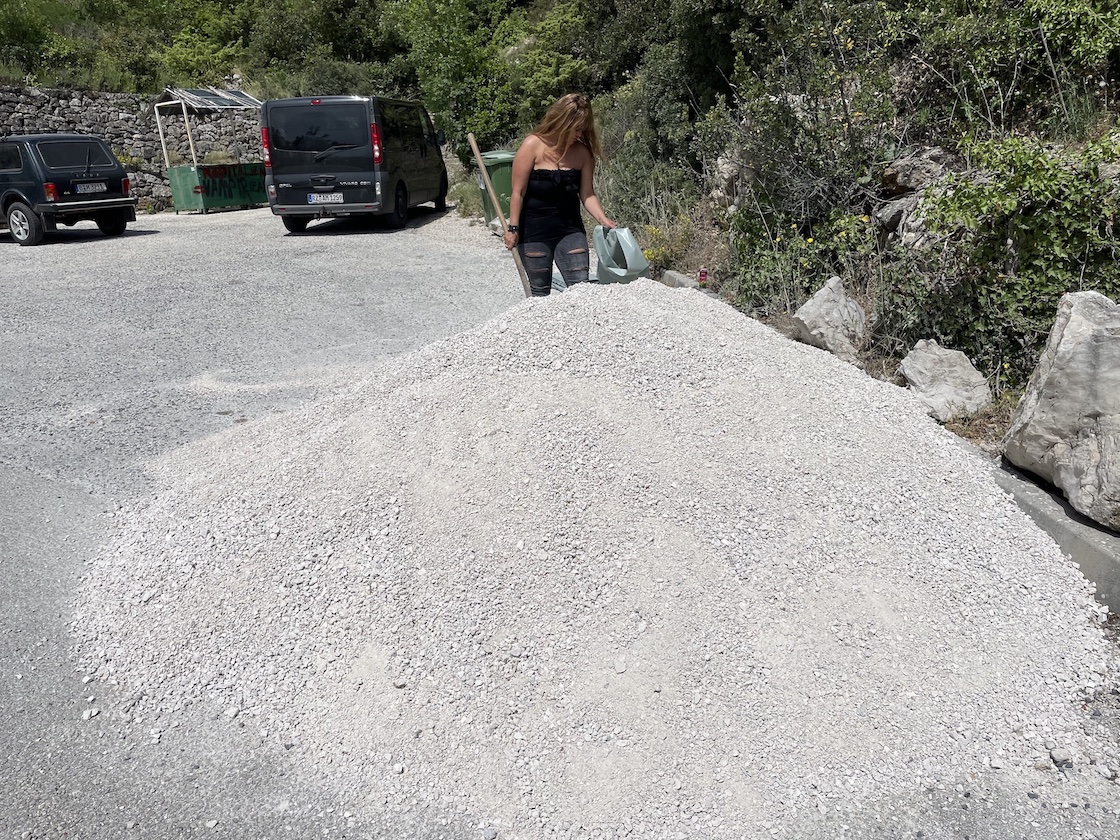
    We never quite fully understood Camus’ famous quote from the end of his philosophical essay The Myth of Sisyphus until we began this crazy radna akcija (“work action”) that lasted from May to September 2022. It took us around three months, plenty of work actions during the summer, and numerous friends and volunteers to carry around 8 tonnes of material uphill – around 400 bags of sand and 45 bags of cement – that will be used for the renovation of the old stone house.

    During these three months, at least 50 people helped in one way or another, while 10–15 were the most persistent and sometimes even fanatical (not wanting to stop working). One of them spent the entire day carrying sand bags uphill (each bag weighing approximately 20-30 kg). Some did less, but in the end, what counts is the collective spirit and determination to continue even when the whole mission looked like a never-ending Mediterranean version of “Fitzcarraldo.”

    Take a look at our gallery and our tired and happy faces:

  • The Mediterranean

    The Mediterranean

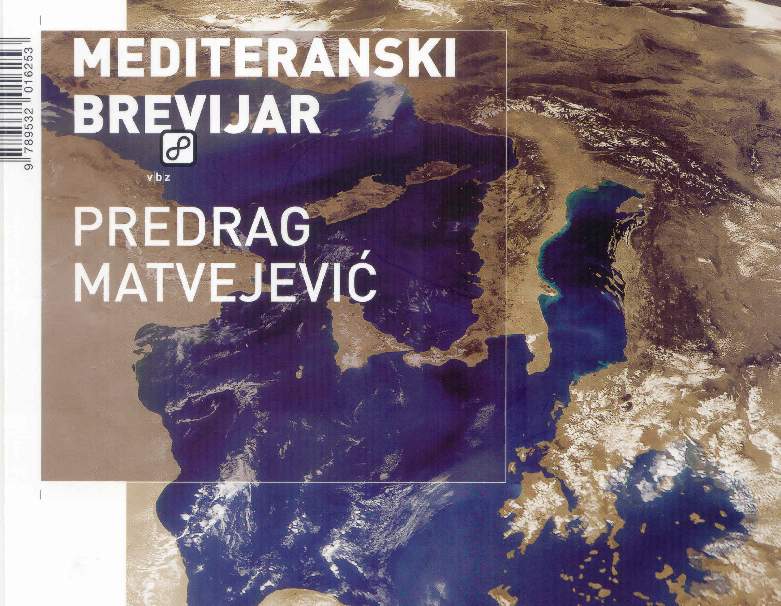
    The Mediterranean is no less than thousands of things together. Not merely single sceneries, but countless ones. Not a single sea, but a succession of seas. Not a mere civilization, but heaps of civilizations piling on top of each other. The Mediterranean is a historically old crossroad: for several millennia, everything centered around it, muddling, yet enriching its history. Although much has been said and retold about the ‘Mare Nostrum’, it is fortunate that there is always something new to add about its unity, divisions, transparencies and obscurities. We have known for long that it is neither ‘a given reality’ nor a ‘constant’, for the Mediterranean is composed of several subsets that defy or refute several ideas received.

    Predrag Matvejević

    Read more: Darko Suvin on Predrag Matvejević

  • Henry David Thoreau

    Henry David Thoreau


    I went to the woods because I wished to live deliberately, to front only the essential facts of life, and see if I could not learn what it had to teach, and not, when I came to die, discover that I had not lived. I did not wish to live what was not life, living is so dear; nor did I wish to practice resignation, unless it was quite necessary. I wanted to live deep and suck out all the marrow of life, to live so sturdily and Spartan-like as to put to rout all that was not life, to cut a broad swath and shave close, to drive life into a corner, and reduce it to its lowest terms, and, if it proved to be mean, why then to get the whole and genuine meanness of it, and publish its meanness to the world; or if it were sublime, to know it by experience, and be able to give a true account of it in my next excursion.

    Henry David Thoreau, Walden, 1854

    Similarly to how Thoreau built his cabin near Walden Pond in 1845 from recycled and hand-cut materials, we’re starting from scratch to build the school in the woods of Vis. Arriving at Harvard as a 16-year-old, he encountered a system that he called “superficial scholarship” as opposed to real knowledge. After Thoreau graduated from Harvard, he and his brother John set up their own school. They surveyed the school grounds and planted crops with the students, who learned basic mathematics and science along the way. And they took numerous journeys to outdoor sites — hence the term “field trips” — where the students found out about local history and gained access to local knowledge. Thoreau understood education not simply as a means of preparation for something (a job or a career), but as something that is intrinsically valuable. Through his writings and his “experiments” in nature, Thoreau made real progress in unlearning and relearning what we thought we knew. His concept of learning, besides being critical of authority and state structures, involves an intense observation of the natural world and the inner self that is also one of the missions of ISSA.

    In honor to the great thinker and doer, one day we will build a replica of Thoreau’s cabin at the School of ISSA and offer it as a residency for writers.

  • Pedagogy of the Opressed

    Pedagogy of the Opressed

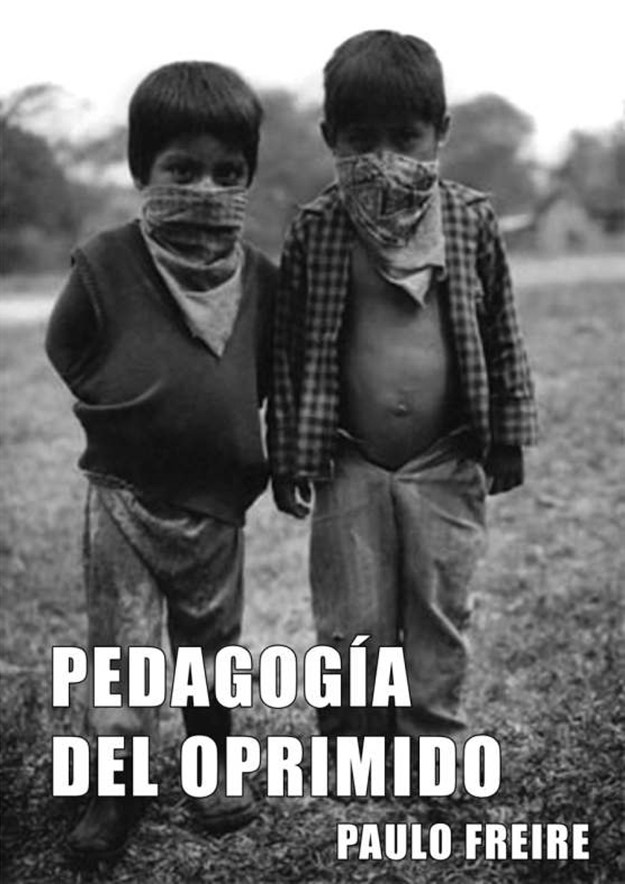
    In his seminal work “Pedagogy of the Oppressed”, Brazilian educator Paulo Freire argues for a pedagogy that treats the learner as a co-creator of knowledge. He dismisses traditional pedagogy as the “banking model of education” which approaches the student as an empty vessel to be filled with knowledge, and instead proposes a problem-posing model wherein the processes of education is necessarily dialogical. As one of the foundational texts of critical pedagogy, Freire’s lessons resonate strongly with our praxis.

    “Education either functions as an instrument which is used to facilitate integration of the younger generation into the logic of the present system and bring about conformity or it becomes the practice of freedom, the means by which men and women deal critically and creatively with reality and discover how to participate in the transformation of their world.”

    “For apart from inquiry, apart from the praxis, individuals cannot be truly human. Knowledge emerges only through invention and re-invention, through the restless, impatient, continuing, hopeful inquiry human beings pursue in the world, with the world, and with each other.”

    “Through dialogue, the teacher-of-the-students and the students-of-the-teacher cease to exist and a new term emerges: teacher-student with students-teachers. The teacher is no longer merely the-one-who-teaches, but one who is himself taught in dialogue with the students, who in turn while being taught also teach. They become jointly responsible for a process in which all grow. In this process, arguments based on “authority” are no longer valid; in order to function, authority must be on the side of freedom, not against it. Here, no one teaches another, nor is anyone self-taught.”

    “There’s no such thing as neutral education. Education either functions as an instrument to bring about conformity or freedom.”

  • About ISSA

    About ISSA

    The Island School of Social Autonomy (ISSA) is a place that imagines, experiments with, and cultivates forms of knowledge production and sharing that go beyond traditional notions of education and its purpose. It also fosters modes of living that extend beyond mere survival in the “age of extinction.”

    We perceive social autonomy as the ability of individuals to function as cooperative group members, engaging in communal self-governance while being aware of the interconnectedness and interdependence of communities within broader networks (or archipelagoes) of human and non-human life-organization. Autonomy does not imply isolation but rather the ability to make autonomous decisions, through mechanisms of collective deliberation, about how to live together and take responsibility for caring for those that are not able to make them (children, non-human living worlds, etc.)

    With ISSA, our aim is to cultivate ways of living, learning, and teaching together. We seek to explore autonomy as a political strategy and a model for social organization. Additionally, we adopt a hands-on approach to design, experimentation, and the implementation of processes, goods, and services. We collaboratively engage in discussions, physical labor, and the development of joint projects and programs, working with individuals and collectives. Throughout our endeavors, we remain guided by our motto: “We build the school, the school builds us” (“Mi gradimo školu, škola gradi nas”).

    Why a School?

    We’re starting a School on an island in the middle of the Adriatic Sea because we believe that the future lies in the archipelagos of autonomy. Moreover, we recognize that the contemporary educational system, as highlighted by the eminent educator and philosopher Ivan Illich in his groundbreaking book “Deschooling Society” (1971), has turned into an “advertising agency that makes you believe that you need the society as it is”.

    Education as we know it, is a relatively recent invention. Until the 19th century, children from middle-class families were educated at home with the assistance of private tutors. It was only with the rise of industrial society that the modern school system became the central mediator of socialization. This shift resulted in the removal of socialization from both the family and the community. The education system transformed into a statist institution rather than a communal one, thus becoming one of the fundamental pillars of social order, based on nation-states, their economies, and various hierarchies related to gender, race, and more.


    Throughout the 20th century, the prevailing model of education transformed into a process that engineered consumers who propelled economic “growth” and (national) citizens responsible for political rights and obligations. In the 21st century, the privatization of education and knowledge, coupled with the penetration of technology into every sphere of life, including education, led to the proliferation of techno-solutionist approaches and reasoning. As Wendi Brown notes this diminishing separation between economy and polity brought about a situation wherein political principles of equality and freedom no longer figure as alternative social and moral referents to those of the market. Contrary to this, we want to create condition where public resources are not to be used “for some new device that makes people learn” but for, as Ivan Illich suggested, “the creation of a new style of educational relationship between man and his environment. To foster this style, attitudes toward growing up, the tools available for learning, and the quality and structure of daily life will have to change simultaneously.”

    Illich observed that urban life tends to become increasingly reliant on bureaucratic civic services, which in our present context, can be viewed as bureaucratic business services. We now heavily rely on complex technological systems owned by large private tech companies in almost every aspect of our lives. This trend of data collection, surveillance, and behavioral engineering promotes predictable and automated human behavior. Illich diagnosed this particular way of life as an ideal “pan-hygienic world,” a world where all interactions between individuals and between individuals and their surroundings result from foresight and manipulation. The school itself has “become the planned process that tools man for a planned world, the principal tool to trap man in man’s trap.”


    What is missing in this reality is the essence of the true master-disciple relationship. It is not about simply reproducing socially “suitable” individuals, but about a shared understanding between the master and pupil that their relationship is invaluable and mutually beneficial.

    Aristotle referred to this relationship as a “moral type of friendship” that operates without fixed terms. The master acts towards the pupil as they would towards a friend, providing gifts or engaging in any other action out of genuine care. Thomas Aquinas described this form of teaching as an act of love and mercy. Illich reminds us that this kind of teaching is always a luxury for the teacher and a form of leisure (from the Greek term skhole, from which our word “school” originates) for both the teacher and the pupil. It is an activity that holds meaning for both parties and serves no ulterior purpose.

    In the current convergence of multiple crises (environmental, political, economic, etc.), it is precisely this form of teaching, devoid of fixed terms, which functions as a moral type of friendship that must be reinvented. Although it may not prevent mass extinction, it has the potential to create an actual, existing social and educational experiment and provide a platform for contemplating a different world.

    Why Vis?

    “I am at the Philippines of the Adriatic,” wrote the great poet Tin Ujević of his trip to the island of Vis in 1930. “I find myself in the deep heart of the deep sea. It was the fairies themselves who brought me here, on an unknown date when the globe fell asleep, and no one could see me. I am a part of the empire of adventures, a miracle of events. I finally experienced what the world has forgotten. And I became the owner of a mystery.”

    Vis’ mystery to us seems rooted in both its philosophy of pomalo (“take it slow” or festina lente) and the fact that throughout its history it was always distant enough to remain mysterious while also being at the center of events.

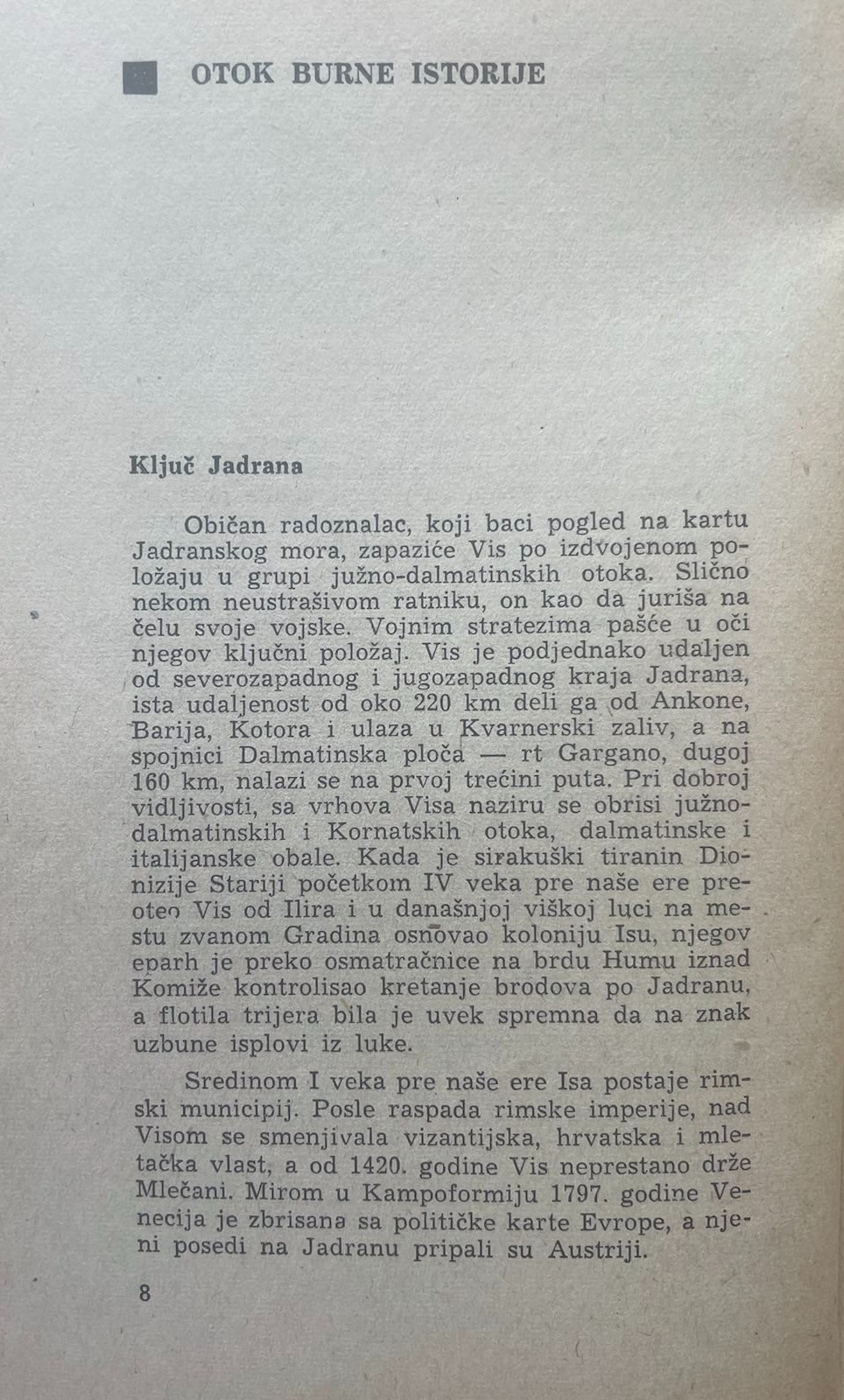
    The earliest known inhabitants of Vis were Illyrian tribes, most likely Liburni, who settled on the island during the late Bronze Age. In the 4th century BC, ancient Greeks colonized the island when Dionysius the Elder, the tyrant of Syracuse, founded the colony of Issa. It later became an independent polis, with its own currency and colonies. Subsequently, it became a part of the Roman Empire until its collapse. From then until 1797, Vis was under the rule of the Republic of Venice, after which it was passed to Napoleon and then to the Kingdom of Italy. The island was then ruled by the Austrian Empire for over a century. Following World War I, it briefly became part of Italy once again and later joined the Kingdom of Yugoslavia.


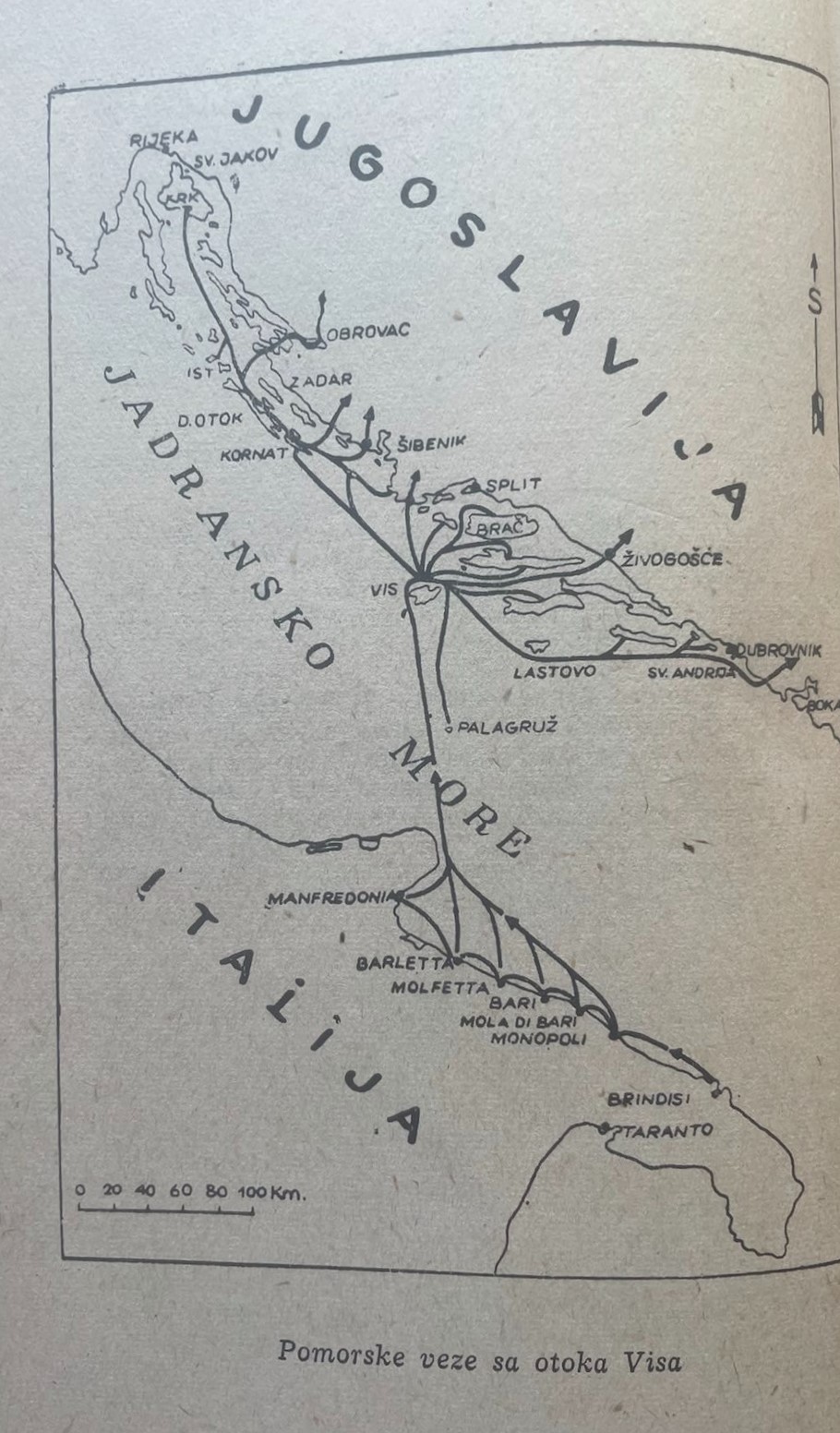
    During World War II, after a two-year fascist occupation, Vis became the starting point for the final phase of the Yugoslav antifascist liberation struggle. Interestingly, it was the Yugoslav People’s Army (JNA) that removed the island from tourist maps and preserved some of its authenticity. From 1944 until the collapse of Yugoslavia in 1991, Vis served as one of the strategically crucial Adriatic army bases, prohibiting foreign visitors. It remained relatively untouched by global tourism until the late 1990s.

    Apart from its intriguing history, what distinguishes Vis is its geological past. The Vis Archipelago consists partially of the oldest rocks in the Adriatic Sea, dating back around 220 million years. This uniqueness sets it apart from other Adriatic islands. During that time, there was an active volcano deep beneath the surface, and if one knows where to look, petrified lava, volcanic bombs, ash, salt, and sedimentary rocks can still be found along the beaches of Komiža. Additionally, Vis benefits from its own water sources, unlike the rest of the Adriatic islands.


    It is not a romantic notion of “escaping” catastrophe because we are well aware that there is no escape. Climate crisis, microplastics, capitalism, and other challenges are reaching even the most remote shores. Nor is it merely a variation of Voltaire’s famous line from “Candide” that suggests we should tend to our own garden, implying that self-sufficiency is both possible and desirable on “our” island.

    The selection of Vis represents a symbolic gesture, affirming the significance of certain local characteristics that we find important, such as pomalo or the antifascist legacy. Simultaneously, it is a coincidence, an accidental convergence of people, ideas, and energies, as well as a personal and collective decision made every day. It serves as a reminder that we always find ourselves in a tangible material reality fixed in a specific place while being shaped by processes originating elsewhere.

    Similar to ISSA itself, the island of Vis embodies an essential dialectic relationship between autonomy and dependency, nature and society, local and global. For ISSA, it is not an either-or situation.

    Why Here and Now?

    In Aldous Huxley’s utopian novel “Island,” he writes about an imaginary island located somewhere in the Pacific Ocean. The society inhabiting this island enjoys universal economic well-being and a high level of respect for individual rights and freedoms. Individuals are also provided ample opportunities for emotional and spiritual growth. Among the island’s many peculiarities are specially trained birds called mynas, whose purpose is to intermittently screech out “Attention!” and “Karuṇā,” reminding the inhabitants to live in the present moment and cultivate compassion. The island remains untainted by modern-day civilization, capitalism, imperialism, and domination. However, it is destined to be engulfed by these forces.

    Our island is not innocent, and we acknowledge that there is no outside. We are deeply entrenched within the belly of the beast. We understand that we are starting from a point of ruins, destruction, and smoke. Yet, our island is not alone; it is part of an archipelago consisting of isles, caves, valleys, and swamps where alternative forms of life persist or are reborn. These possibilities exist within the philosophy of buen vivir embraced by indigenous groups in South America, in Jason Moore’s concept of world-ecology, in shadow libraries hosted on secret servers, in the notion of public wealth, in participatory processes within communities, and countless other places and spaces.

    In conclusion, as the impending catastrophes we face are both local and global in nature, so too is ISSA. Our school is not merely a space for contemplation but a place of action. Its role is to explore and address the significant challenges ahead through the process of teaching and learning, while also practicing social autonomy in the present moment.

    Faced with the end of the world, how do we educate ourselves for the “age of extinction”? What type of education do we need to secure a future? Moreover, how can we achieve a “good life” amidst extinction, and what does “good life” truly mean? Finally, what forms of social organization and coexistence can we foster because of, or despite, the impending disaster?

    You might also want to read Bifo’s text “Why starting a School today?”

  • Plato in Issa?

    Plato in Issa?

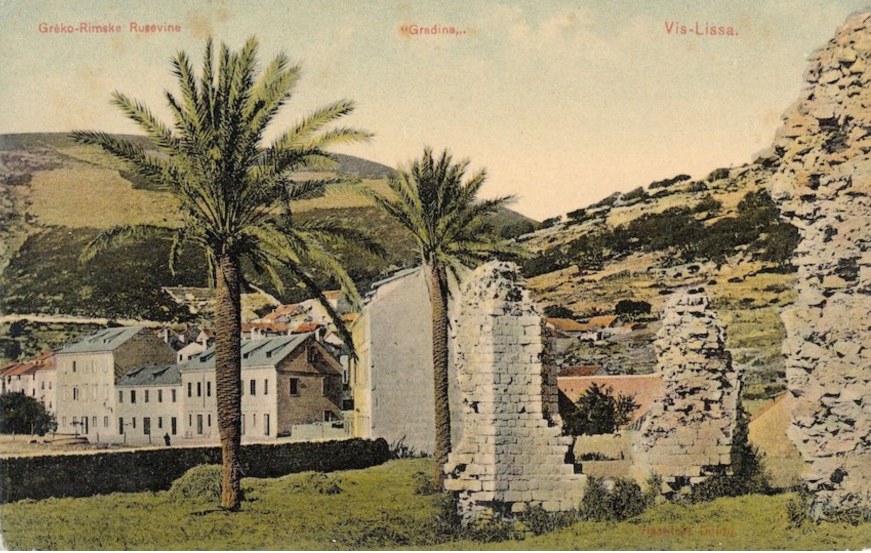
    Ancient Greek-Roman ruins on island Vis, remains of Issa

    As crazy as it sounds, it is possible – and, indeed, likely – that the ancient Greek philosopher Plato visited Vis. Unfortunately, there are no traces of his possible stay yet: even though Issa represented the most important polis in this part of the Mediterranean, not even 10 % of the 120,000 m2 of the ancient city has been excavated until today.

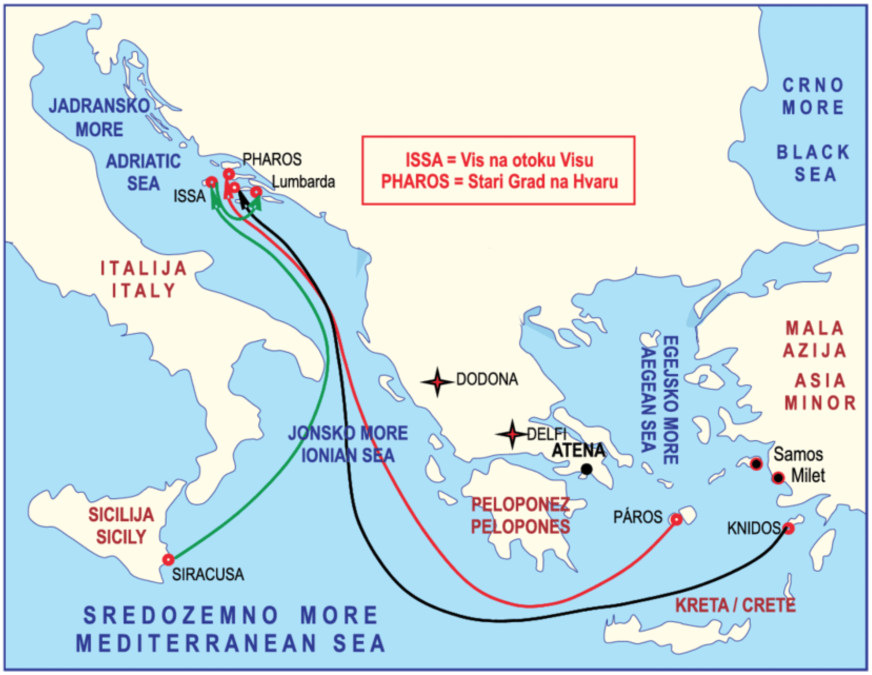
    Vis has been inhabited since the Neolithic period. It was in 397 BC that the Greek tyrant of Syracuse, Dionysius the Elder, founded the colony of Issa on the island that would later become an autonomous and independent polis and establish its own colonies – the most notable of which is today’s Split. Dionysius the Elder, a tyrant of the worst kind who would later appear in Dante’s Inferno, was known for transforming Syracuse into the most powerful city in the Greek world, with an empire extending from Sicily to Italy and the Adriatic island of Issa, from which the name Vis derives.

    He was also known for inviting the philosopher Plato, around 40 years old at the time, to visit his court in Sicily in 388 BC. Plato, who was dreaming of philosopher-kings and wanted to integrate politics and philosophy to create the perfect society, was of course chuffed by the invitation, and soon he befriended Dion, the tyrant’s brother-in-law, who accepted his ideas with enthusiasm. However, the tyrant didn’t like Plato’s philosophy at all. First, he wanted to kill him, and only after Dion’s intervention, Plato’s life spared and he was instead sold as a slave. He was recognized at a slave market in Aegina (Greece), where he was redeemed by Anikeris, who didn’t want to take the money that Plato’s pupils collected to free their teacher.

    This ransom money was instead used to buy a plot of land in the grove of Hekadem, surrounded by olive trees, where the school of philosophy called Akademia was founded. In other words, the creation of Plato’s School in 387 BC – ten years after the foundation of Issa – could perhaps be understood as a consequence of his first failed voyage through the Mediterranean Sea to Syracuse. As we know, the most famous student would soon become Aristotle, who after studying at the Academy for almost twenty years went on to tutor Alexander the Great and later founded his own school at the Lyceum, which would later turn into the Peripatetic School of Philosophy due to Aristotle’s tendency to walk while teaching.

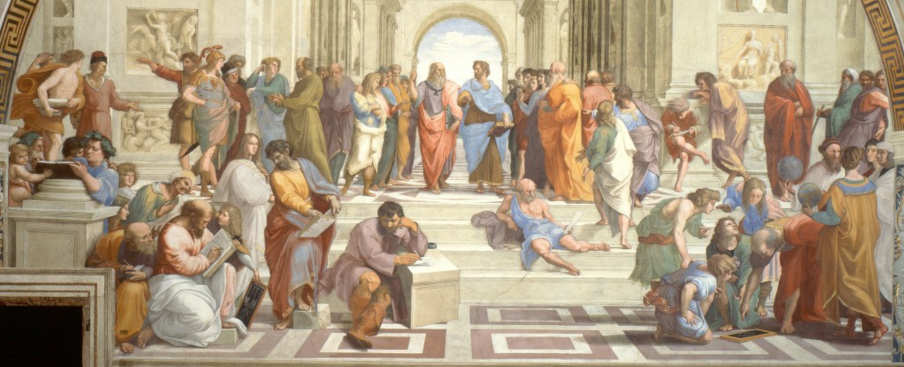
    The School of Athens by Raphael, with Plato & Aristotle at the center

    In 367 BC, exactly thirty years after the foundation of Issa, Dyonisous the Elder died and was succeeded by his son Dionysus II. He was young and a tyrant as well, but Dion succeeded in convincing him to invite Plato to Syracuse again. After his initial hesitation (who wouldn’t hesitate after already being almost killed and sold into slavery?), Plato accepted the invitation and visited Sicily for a second time. But again, the new tyrant didn’t like his ideas, suspecting they would undermine his own position, so Plato was detained. He was eventually set free and returned to Greece, where he would continue teaching at his Academy. Now it already sounds like Plato’s “Groundhog Day,” but in 360 BC, despite all the awful experiences he had already encountered, he accepted the third and final invitation to Syracuse. He would again end up disappointed. Around that time, the tyrant’s empire was already collapsing, and Issa wasn’t a colony of Syracuse anymore; it turned into an independent polis that started to build its own empire in this part of the Adriatic Sea and the Adriatic coast of modern-day Croatia.

    Recent and older archaeological, historical, and seafaring evidence suggests that the route Plato may have travelled to Syracuse was one of the most important ancient seafaring routes used by the Greeks at that time. It followed the string of islands that stretched from the coast of present-day Split via Hvar (Pharos) and Vis (Issa). The historical and archaeological evidence from these colonies and later poleis, including the numerous caves found on both the islands of Hvar and Vis, evoke important elements of Plato’s Republic, such as land division or polis public institutions, and possibly even the famous Allegory of the Cave.

    According to Harald Haamann’s recent book Plato’s Philosophy: Reaching Beyond the Limits of Reason, “Plato could have joined the various groups of founding colonists and tried to persuade them to implement his vision of an “ideal state.”In theory, Plato could have also visited Issa and maybe he contributed to the foundation of the new polis.

    Greek colonies in the Adriatic Sea – Issa, Pharos – and its routes from Syrcause, Paros and Knidos

    Whether Plato visited Issa or not, we may never find out, but Plato’s comparison of philosophy to a second navigation, the one that starts when favorable winds stop blowing and the ship remains immobile, is even more pertinent today. The role of philosophy is precisely to navigate when sailing has become impossible. The philosopher is a navigator who gazes at the stars and sky and understands the seasons and winds, including the play of shadows in the cave. What if, instead of sailing to Syracuse, Plato simply decided to stay on Issa? And what if, unlike Plato’s desire, we do not need philosopher-kings anymore but a simple and modest community of navigators?

  • ISSA Garden: Hibiscus and Cypress

    ISSA Garden: Hibiscus and Cypress

    A big part of our school is our ISSA Garden. The garden, like the rest of our plans for the school, awaits our learning, experimenting, and exploring, while dealing with the climate crisis – lack of rain, prolonged droughts, and stronger storms. This is a long-term project, but also one that by its nature never stops, and we are eager to start learning about all the various cultures and seedlings, the different methods (from permaculture to forest gardens), and the different ways of water collection and redistribution.

    So instead of drowning in post-apocalyptic melancholy and climate anxiety, we decided not to lose another autumn without planting anything around the school, on its terraces.

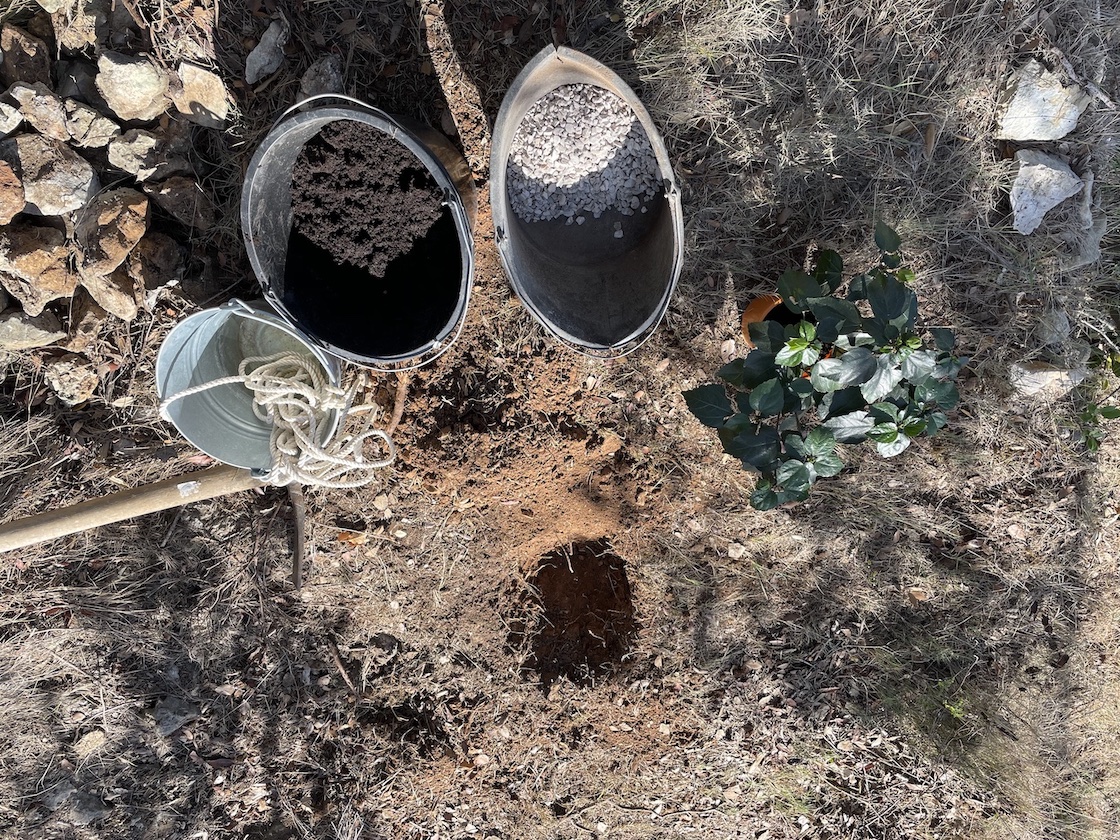
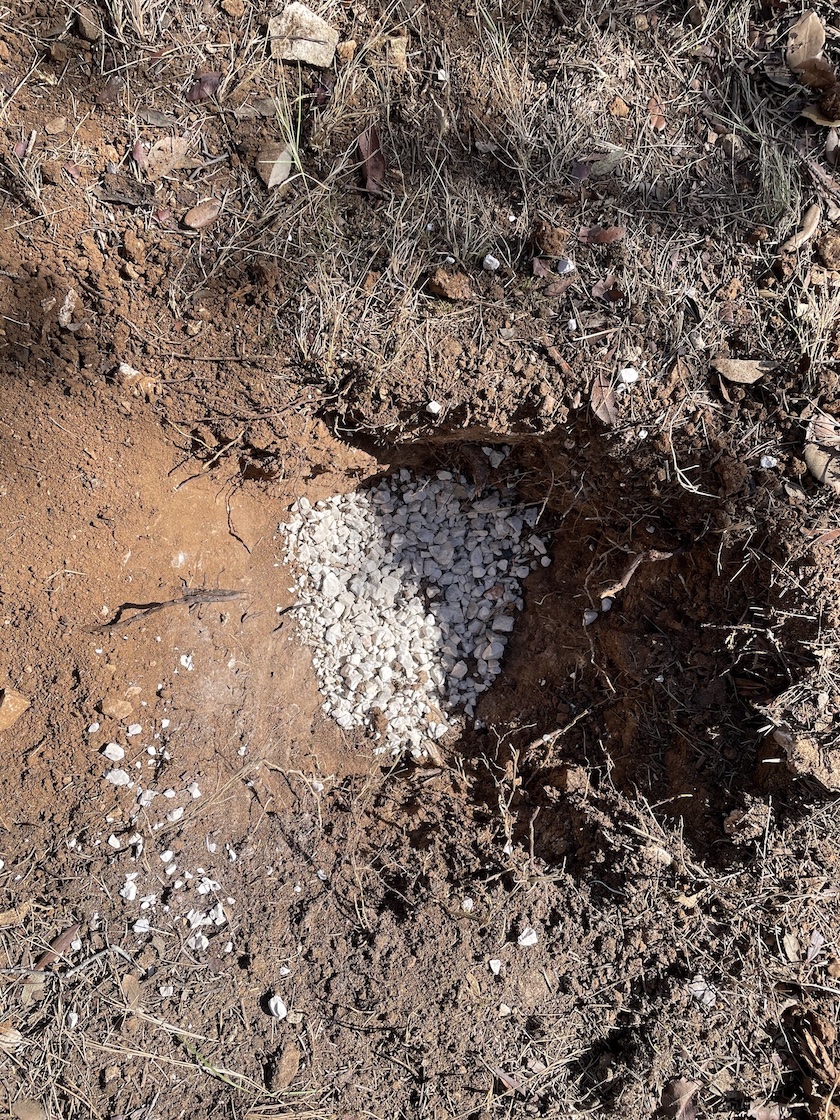
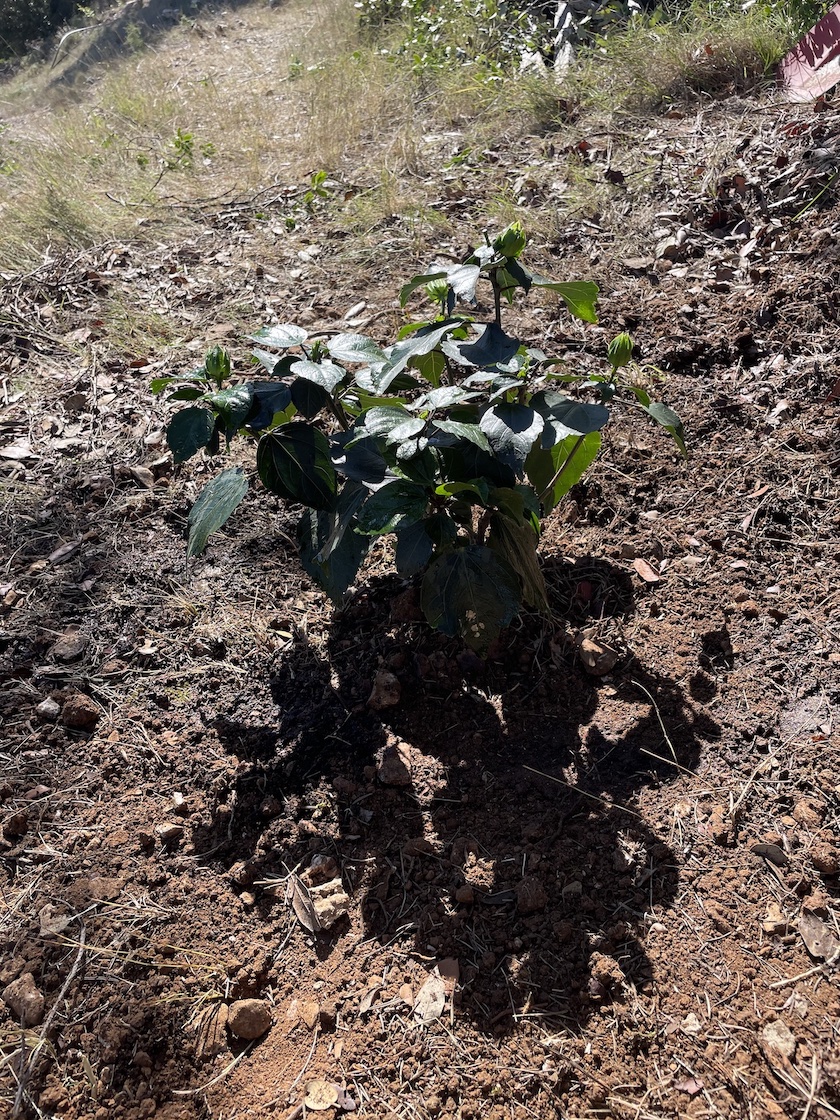
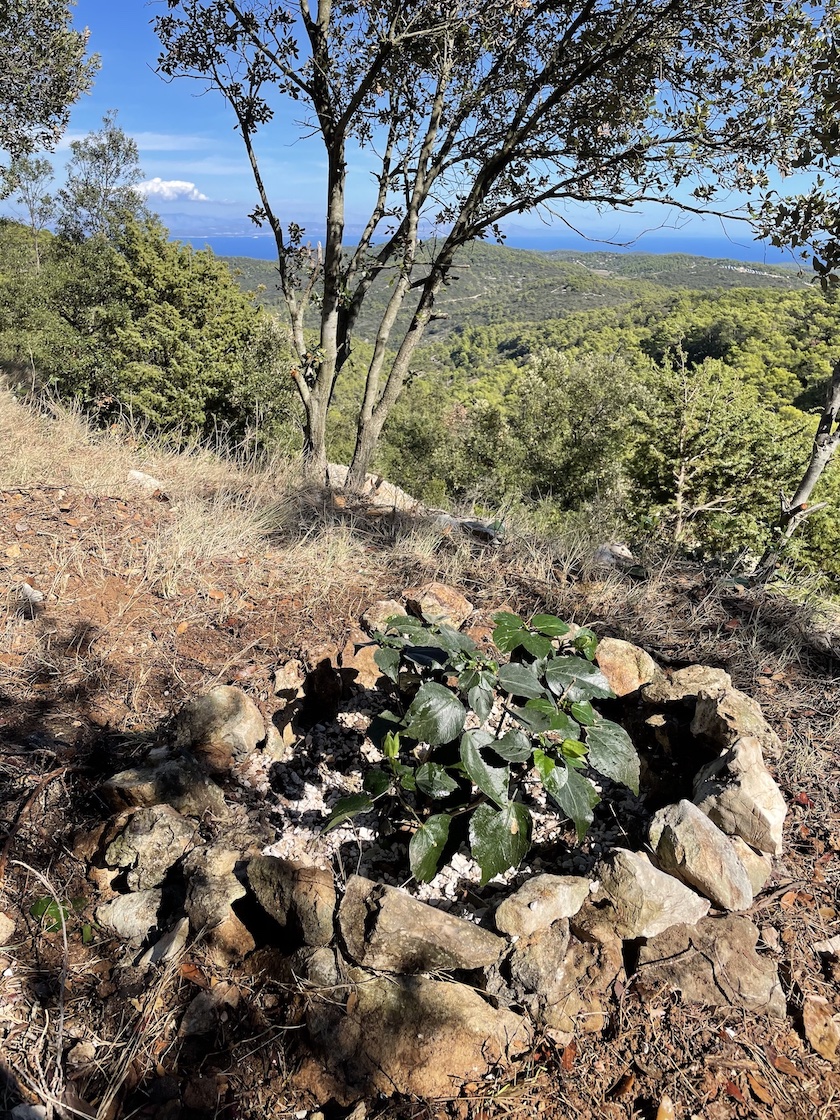
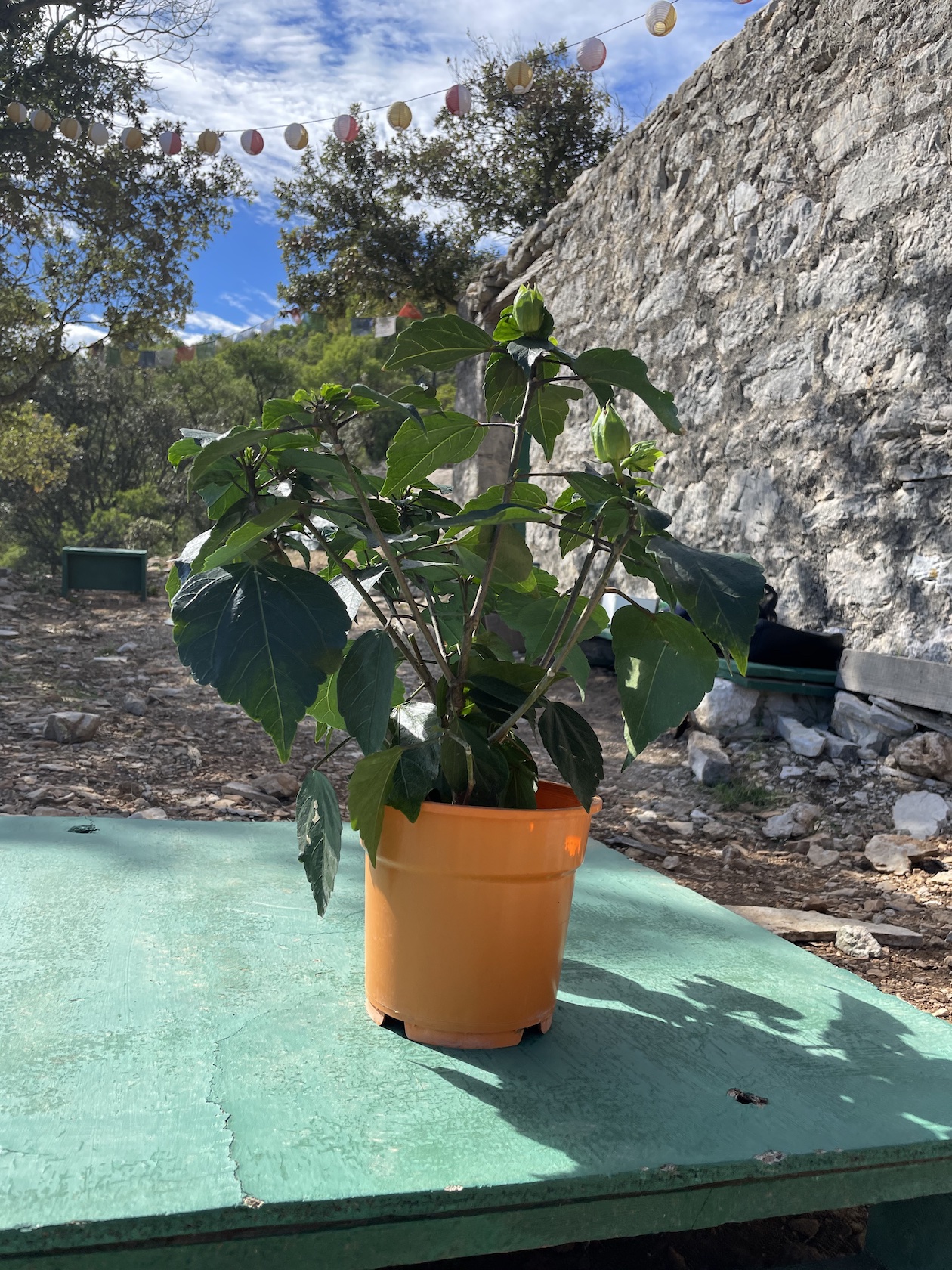
    We started with a hibiscus seedling, a plant that arrived in Europe during the 16th century, although the ancestors of modern hibiscus hybrids were scattered all around the globe, following the equator from one warm, tropical land to another. The eight hibiscus species considered to be the ancestors of the modern exotic hibiscus originated in Mauritius, Madagascar, Fiji, Hawaii, and either China or India.

    We had to seize the opportunity and plant our first hibiscus.

    Hibiscus is also known as “flower of an hour”, because some believe that when someone gives you a hibiscus, they are telling you to enjoy every moment of life, that is, to seize the opportunity, because the hibiscus flower only lasts for one day and is replaced the next day by others, and so on until autumn.

    We planted a young cypress tree from the Island of Vis after planting our first hibiscus in hopes that it will take advantage of the sun uphill and its roots will join the existing underground roots network.

    Cypress is usually an extremely long-lived tree; specimens have been recorded that have reached the age of a few thousand years, although the cypress usually lives a few centuries. It originated in northern Iran and spread throughout Asia Minor, Crete, and Cyprus, as well as the entire Mediterranean.

    Many ancient peoples planted it around temples and considered it a sacred tree. The Phoenicians and Egyptians valued it as an ancient tree that does not rot but instead hardens in water. That is why they used it to build sarcophagi, ships, temple doors, and statues of deities.

    In Greek and Roman tradition, it is associated with the deities of the underworld (Hades and Pluto) and the renewal of life, because its evergreen leaves and incorruptible wood evoke immortality. That is why it is still commonly found today in the cemeteries of the Mediterranean.

    We will keep you updated about the evolution of these two beautiful beings, our first hibiscus tree and our first cypress tree. This is just a modest and hopeful beginning.

  • Michel Foucault: Of Other Spaces

    Michel Foucault: Of Other Spaces

    The great obsession of the nineteenth century was, as we know, history: with its themes of development and of suspension, of crisis, and cycle, themes of the ever-accumulating past, with its great preponderance of dead men and the menacing glaciation of the world. The nineteenth century found its essential mythological resources in the second principle of thermodynamics. The present epoch will perhaps be above all the epoch of space. We are in the epoch of simultaneity: we are in the epoch of juxtaposition, the epoch of the near and far, of the side-by-side, of the dispersed. We are at a moment, I believe, when our experience of the world is less that of a long life developing through time than that of a network that connects points and intersects with its own skein. One could perhaps say that certain ideological conflicts animating present-day polemics oppose the pious descendents of time and the determined inhabitants of space. Structuralism, or at least which is grouped under this slightly too general name, is the effort to establish, between elements that could have been connected on a temporal axis, an ensemble of relations that makes them appear as juxtaposed, set off against one another, implicated by each other—that makes them appear, in short, as a sort of configuration. Actually, structuralism does not entail denial of time; it does involve a certain manner of dealing with what we call time and what we call history.

    Yet it is necessary to notice that the space which today appears to form the horizon of our concerns, our theory, our systems, is not an innovation; space itself has a history in Western experience, and it is not possible to disregard the fatal intersection of time with space. One could say, by way of retracing this history of space very roughly, that in the Middle Ages there was a hierarchic ensemble of places: sacred places and profane places: protected places and open, exposed places: urban places and rural places (all these concern the real life of men). In cosmological theory, there were the supercelestial places as opposed to the celestial, and the celestial place was in its turn opposed to the terrestrial place. There were places where things had been put because they had been violently displaced, and then on the contrary places where things found their  natural ground and stability. It was this complete hierarchy, this opposition, this intersection of places that constituted what could very roughly be called medieval space: the space of emplacement.

    This space of emplacement was opened up by Galileo. For the real scandal of Galileo’s work lay not so much in his discovery, or rediscovery, that the earth revolved around the sun, but in his constitution of an infinite, and infinitely open space. In such a space the place of the Middle Ages turned out to be dissolved, as it were; a thing’s place was no longer anything but a point in its

    movement, just as the stability of a thing was only its movement indefinitely slowed down. In other words, starting with Galileo and the seventeenth century, extension was substituted for localization.

    Today the site has been substituted for extension which itself had replaced emplacement. The site is defined by relations of proximity between points or elements; formally, we can describe these relations as series, trees, or grids. Moreover, the importance of the site as a problem in contemporary technical work is well known: the storage of data or of the intermediate results of a calculation in the memory of a machine, the circulation of discrete elements with a random output (automobile traffic is a simple case, or indeed the sounds on a telephone line); the identification of marked or coded elements inside a set that may be randomly distributed, or may be arranged according to single or to multiple classifications.

    In a still more concrete manner, the problem of siting or placement arises for mankind in terms of demography. This problem of the human site or living space is not simply that of knowing whether there will be enough space for men in the world—a problem that is certainly quite important—but also that of knowing what relations of propinquity, what type of storage,  circulation, marking, and classification of human elements should be adopted in a given situation in order to achieve a given end. Our epoch is one in which space takes for us the form of relations among sites.

    In any case I believe that the anxiety of our era has to do fundamentally with space, no doubt a great deal more than with time. Time probably appears to us only as one of the various distributive operations that are possible for the elements that are spread out in space,

    Now, despite all the techniques for appropriating space, despite  the whole network of knowledge that enables us to delimit or to formalize it, contemporary space is perhaps still not entirely desanctified (apparently unlike time, it would seem, which was detached from the sacred in the nineteenth century). To be sure a certain theoretical desanctification of space (the one signaled by Galileo’s work) has occurred, but we may still not have reached the point of a practical desanctification of space. And perhaps our life is still governed by a certain number of oppositions that remain inviolable, that our institutions and practices have not yet dared to break down. These  are oppositions that we regard as simple givens: for example between private space and public space, between family space and social space, between cultural space and useful space, between the space of leisure and that of work. All these are still nurtured by the hidden presence of the sacred.

    Bachelard’s monumental work and the descriptions of phenomenologists have taught us that we do not live in a homogeneous and empty space, but on the contrary in a space thoroughly imbued with quantities and perhaps thoroughly fantasmatic as well. The space of our primary perception, the space of our

    dreams and that of our passions hold within themselves qualities that seem intrinsic: there is a light, ethereal, transparent space, or again a dark, rough, encumbered space; a space from above, of summits, or on the contrary a space from below of mud; or again a space that can be flowing like sparkling water, or space that is fixed, congealed, like stone or crystal. Yet these analyses, while fundamental for reflection in our time, primarily concern internal space. I should like to speak now of external space.

    The space in which we live, which draws us out of ourselves, in which the erosion of our lives, our time and our history occurs, the space that claws and gnaws at us, is also, in itself, a heterogeneous space. In other words, we do not live in a kind of void, inside of which we could place individuals and things. We do not live inside a void that could be colored with diverse shades of light, we live inside a set of relations that delineates sites which are irreducible to one another and absolutely not superimposable on one another.

    Of course one might attempt to describe these different sites by looking for the set of relations by which a given site can be defined. For example, describing the set of relations that define the sites of transportation, streets, trains (a train is an extraordinary bundle of relations because it is something through which one goes, it is also something by means of which one can go from one point to another, and then it is also something that goes by). One could describe, via the cluster of relations that allows them to be defined, the sites of temporary relaxation—cafes, cinemas, beaches. Likewise one could describe, via  its network of relations, the closed or semi-closed sites of rest—the house, the bedroom, the bed, et cetera. But among all these sites, I am interested in certain ones that have the curious property of being in relation with all the other sites, but in such a way as to suspect, neutralize, or invent the set of relations that they happen to designate, mirror, or reflect. These spaces, as it were, which are linked with all the others, which however contradict all the other sites, are of two main types.

    HETEROTOPIAS

    First there are the utopias. Utopias are sites with no real place. They are sites that have a general relation of direct or inverted analogy with the real space of Society. They present society itself in a perfected form, or else society turned upside down, but in any case these utopias are fundamentally unreal spaces.

    There are also, probably in every culture, in every civilization, real places—places that do exist and that are formed in the very founding of society— which are something like counter-sites, a kind of effectively enacted utopia in which the real sites, all the other real sites that can be found within the culture, are simultaneously represented, contested, and inverted. Places of this kind are

    outside of all places, even though it may be possible to indicate their location in reality. Because these places are absolutely different from all the sites that they reflect and speak about, I shall call them, by way of contrast to utopias, heterotopias. I believe that between utopias and these quite other sites, these heterotopias, there might be a sort of mixed, joint experience, which would be the mirror. The mirror is, after all, a utopia, since it is a placeless place. In the mirror, I see myself there where I am not, in an unreal, virtual space that opens up behind the surface; I am over there, there where I am not, a sort of shadow that gives my own visibility to myself, that enables me to see myself there where I am absent: such is the utopia of the mirror. But it is also a heterotopia in so far as the mirror does exist in reality, where it exerts a sort of counteraction on the position that I occupy. From the standpoint of the mirror I discover my absence from the place where I am since I see myself over there. Starting from this gaze that is, as it were, directed toward me, from the ground of this virtual space that is on the other side of the glass, I come back toward myself; I begin again to direct my eyes toward myself and to reconstitute myself there where I am. The mirror functions as a heterotopia in this respect: it makes this place that I occupy at the moment when I look at myself in the glass at once  absolutely real, connected with all the space that surrounds it, and absolutely unreal, since in order to be perceived it has to pass through this virtual point which is over there.

    As for the heterotopias as such, how can they be described? What meaning do they have? We might imagine a sort of systematic description—I do not say a science because the term is too galvanized now—that would, in a given society, take as its object the study, analysis, description, and ‘reading’ (as some like to say nowadays) of these different spaces, of these other places. As a sort of simultaneously mythic and real contestation of the space in which we live, this description could be called heterotopology.

    Its first principle is that there is probably not a single culture in the world that fails to constitute heterotopias. That is a constant of every human group. But the heterotopias obviously take quite varied forms, and perhaps no one absolutely universal form of heterotopia would be found. We can however class them in two main categories.

    In the so-called primitive societies, there is a certain form of heterotopia that I would call crisis heterotopias, i.e., there are privileged or sacred or forbidden places, reserved for individuals who are, in relation to society and to the human environment in which they live, in a state of crisis: adolescents, menstruating women, pregnant  women, the elderly, etc. In out society, these crisis heterotopias are persistently disappearing, though a few remnants can still be found. For example, the boarding school, in its nineteenth-century form, or military service for young men, have certainly played such a role, as the first manifestations of sexual virility were in fact supposed to take place “elsewhere”

    than at home. For girls, there was, until the middle of the twentieth century, a tradition called the “honeymoon trip” which was an ancestral theme. The young woman’s deflowering could take place “nowhere” and, at the moment of its occurrence the train or honeymoon hotel was indeed the place of this nowhere, this heterotopia without geographical markers.

    But these heterotopias of crisis are disappearing today and are being replaced, I believe, by what we might call heterotopias of deviation: those in which individuals whose behavior is deviant in relation to the required mean or norm are placed. Cases of this are rest homes and psychiatric hospitals, and of course prisons, and one should perhaps add retirement homes that are, as it were, on the borderline between the heterotopia of crisis and the heterotopia of deviation since, after all, old age is a crisis, but is also a deviation since in our society where leisure is the rule, idleness is a sort of deviation.

    The second principle of this description of heterotopias is that a society, as its history unfolds, can make an existing heterotopia function in a very different fashion; for each heterotopia has a precise and determined function within a society and the same heterotopia can, according to the synchrony of the culture in which it occurs, have one function or another.

    As an example I shall take the strange heterotopia of the cemetery. The cemetery is certainly a place unlike ordinary cultural spaces. It is a space that is however connected with all the sites of the city, state or society or village, etc., since each individual, each family has relatives in the cemetery. In western culture the cemetery has practically always existed. But it has undergone important changes. Until the end of the eighteenth century, the cemetery was placed at the heart of the city, next to the church. In it there was a hierarchy of possible tombs. There was the charnel house in which bodies lost the last traces of individuality, there were a few individual tombs and then there were the tombs inside the church. These latter tombs were themselves of two types, either simply tombstones with an inscription, or mausoleums with statues. This cemetery housed inside the sacred space of the church has taken on a quite different cast in modern civilizations, and curiously, it is in a time when civilization has become ‘atheistic,’ as one says very crudely, that western culture has established what is termed the cult of the dead.

    Basically it was quite natural that, in a time of real belief in the resurrection of bodies and the immortality of the soul, overriding importance was not accorded to the body’s remains. On the contrary, from the moment when people are no longer sure that they have a soul or that the body will regain life, it is perhaps necessary to give much more attention to the dead body, which is ultimately the only trace of our existence in the world and in language. In any case, it is from the beginning of the nineteenth century that everyone has a right to her or his own little box for her or his own little personal decay, but on the

    other hand, it is only from that start of the nineteenth century that cemeteries began to be located at the outside border of cities. In correlation with the individualization of death and the bourgeois appropriation of the cemetery, there arises an obsession with death as an ‘illness.’ The dead, it is supposed, bring illnesses to the living, and it is the presence and proximity of the dead right beside the houses, next to the church, almost in the middle of the street, it is this proximity that propagates death itself. This major theme of illness spread by the contagion in the cemeteries persisted until the end of the eighteenth century, until, during the nineteenth century, the shift of cemeteries toward the suburbs was initiated. The cemeteries then came to constitute, no longer the sacred and immortal heart of the city, but the other city, where each family possesses its dark resting place.

    Third principle. The heterotopia is capable of juxtaposing in a single real place several spaces, several sites that are in themselves incompatible. Thus it is that the theater brings onto the rectangle of the stage, one after the other, a whole series of places that are foreign to one another; thus it is that the cinema is a very odd rectangular room, at the end of which, on a two-dimensional screen, one sees the projection of a three-dimensional space, but perhaps the oldest example of these heterotopias that take the form of contradictory sites is the garden. We must not forget that in the Orient the garden, an astonishing creation that is now a thousand years old, had very deep and seemingly superimposed meanings. The traditional garden of the Persians was a sacred space that was supposed to bring together inside its rectangle four parts representing the four parts of the world, with a space still more sacred than the others that were like an umbilicus, the navel of the world at its center (the basin and water fountain were there); and all the vegetation of the garden was supposed to come together in this space, in this sort of microcosm. As for carpets, they were originally reproductions of gardens (the garden is a rug onto which the whole world comes to enact its symbolic perfection, and the rug is a sort of garden that can move across space).  The garden is the smallest parcel of the world and then it is the totality of the world. The garden has been a sort of happy, universalizing heterotopia since the beginnings of antiquity (our modern zoological gardens spring from that source).

    Fourth principle. Heterotopias are most often linked to slices in time—which is to say that they open onto what might be termed, for the sake of symmetry, heterochronies. The heterotopia begins to function at full capacity when men arrive at a sort of absolute break with their traditional time. This situation shows us that the cemetery is indeed a highly heterotopic place since, for the individual, the cemetery begins with this strange heterochrony, the loss of life, and with this quasi-eternity in which her permanent lot is dissolution and disappearance.

    From a general standpoint, in a society like ours heterotopias and heterochronies are structured and distributed in a relatively complex fashion. First of all, there are heterotopias of indefinitely accumulating time, for example museums and libraries, Museums and libraries have become heterotopias in which time never stops building up and topping its own summit, whereas in the seventeenth century, even at the end of the century, museums and libraries were the expression of an individual choice. By contrast, the idea of accumulating everything, of establishing a sort of general archive, the will to enclose in one place all times, all epochs, all forms, all tastes, the idea of constituting a place of all times that is itself outside of time and inaccessible to its ravages, the project of organizing in this way a sort of perpetual and indefinite accumulation of time in an immobile place, this whole idea belongs to our modernity. The museum and the library are heterotopias that are proper to western culture of the nineteenth century.

    Opposite these heterotopias that are linked to the accumulation of time, there are those linked, on the contrary, to time in its most flowing, transitory, precarious aspect, to time in the mode of the festival. These heterotopias are not oriented toward the eternal, they are rather absolutely temporal [chroniques]. Such, for example, are the fairgrounds, these’ marvelous empty sites on the outskirts of cities that teem once or twice a year with stands, displays, heteroclite objects, wrestlers, snakewomen, fortune-tellers, and so forth. Quite recently, a new kind of temporal heterotopia has been invented: vacation villages, such as those Polynesian villages that offer a compact three weeks of primitive and eternal nudity to the inhabitants of the cities. You see, moreover, that through the two forms of heterotopias that come together here, the heterotopia of the festival and that of the eternity of accumulating time, the huts of Djerba are in a sense relatives of libraries and museums, for the rediscovery of Polynesian life abolishes time; yet the experience is just as much the rediscovery of time, it is as if the entire history of humanity reaching back to its origin were accessible in a sort of immediate knowledge.

    Fifth principle. Heterotopias always presuppose a system of opening and closing that both isolates them and makes them penetrable. In general, the heterotopic site is not freely accessible like a public place. Either the entry is compulsory, as in the case of entering a barracks or a prison, or else the individual has to submit to rites and purifications. To get in one must have a certain permission and make certain gestures. Moreover, there are even heterotopias that are entirely consecrated to these activities of purification—purification that is partly religious and partly hygienic, such as the hammin of the Moslems, or else purification that appears to be purely hygienic, as in Scandinavian saunas.

    There are others, on the contrary, that seem to be pure and simple openings, but that generally hide curious exclusions. Everyone can enter into the

    heterotopic sites, but in fact that is only an illusion—we think we enter where we are, by the very fact that we enter, excluded. I am thinking for example, of the famous bedrooms that existed on the great farms of Brazil and elsewhere  in South America. The entry door did not lead into the central room where the family lived, and every individual or traveler who came by had the right to open this door, to enter into the bedroom and to sleep there for a night. Now these bedrooms were such that the individual who went into them never had access to the family’s quarter the visitor was absolutely the guest in transit, was not really the invited guest. This type of heterotopia, which has practically  disappeared from our civilizations, could perhaps be found in the famous American motel rooms where a man goes with his car and his mistress and where illicit sex is both absolutely sheltered and absolutely hidden, kept isolated without however being allowed out in the open.

    Sixth principle. The last trait of heterotopias is that they have a function in relation to all the space that remains. This function unfolds between two extreme poles. Either their role is to create a space of illusion that exposes every real space, all the sites inside of which human life is partitioned, as still more illusory (perhaps that is the role that was played by those famous brothels of which  we are now deprived). Or else, on the contrary, their role is to create a space that is other, another real space, as perfect, as meticulous, as well arranged as ours is messy, ill constructed, and jumbled. This latter type would be the heterotopia, not of illusion, but of compensation, and I wonder if certain colonies have not functioned somewhat in this manner. In certain cases, they have played, on the level of the general organization of terrestrial space, the role of heterotopias. I am thinking, for example, of the first wave of colonization in the  seventeenth century, of the Puritan societies that the English had founded in America and that were absolutely perfect other places. I am also thinking of those extraordinary Jesuit colonies that were founded in South America: marvelous, absolutely regulated colonies in which human perfection was effectively achieved. The Jesuits of Paraguay established colonies in which existence was regulated at every turn. The village was laid out according to a rigorous plan around a rectangular place at the foot of which was the church; on one side, there was the school; on the other, the cemetery, and then, in front of the church, an avenue set out that another crossed at right angles; each  family had its little cabin along these two axes and thus the sign of Christ was exactly reproduced. Christianity marked the space and geography of the American world with its fundamental sign.

    The daily life of individuals was regulated, not by the whistle, but by the bell. Everyone was awakened at the same time, everyone began work at the same time; meals were at noon and five o’clock, then came bedtime, and at midnight

    came what was called the marital wake-up, that is, at the chime of the churchbell, each person carried out her/his duty.

    Brothels and colonies are two extreme types of heterotopia, and if we think, after all, that the boat is a floating piece of space, a place without a place, that exists by itself, that is closed in on itself and at the same time is given over to the infinity of the sea and that, from port to port, from tack to tack, from brothel to brothel, it goes as far as the colonies in search of the most precious treasures they conceal in their gardens, you will understand why the boat has not only been for our civilization, from the sixteenth century until the present, the great instrument of economic development  (I have not been speaking of that today), but has been simultaneously the greatest reserve of the imagination. The ship is the heterotopia par excellence. In civilizations without boats, dreams dry up, espionage takes the place of adventure, and the police take the place of pirates.

    This text, entitled “Des Espace Autres,” and published by the French journal Architecture /Mouvement/ Continuité in October, 1984, was the basis of a lecture given by Michel Foucault in March 1967.

    From: Architecture /Mouvement/ Continuité, October, 1984; (“Des Espaces Autres,” March 1967 Translated from the French by Jay Miskowiec)

    Although not reviewed for publication by the author and thus not part of the official corpus of his work, the manuscript was relaeased into the public domain for an exhibition in Berlin shortly before Michel Foucault’s death.

    Source: https://web.mit.edu/allanmc/www/foucault1.pdf
  • Ivan Illich: “Deschooling Society”

    Ivan Illich: “Deschooling Society”

    Below you can find the introduction to Ivan Illich’s Deschooling Society, as well as the link to the PDF of the entire book – enjoy!
    INTRODUCTION

    I owe my interest in public education to Everett Reimer. Until we first met in Puerto Rico in 1958, I had never questioned the value of extending obligatory schooling to all people. Together we have come to realize that for most men the right to learn is curtailed by the obligation to attend school. The essays given at CIDOC and gathered in this book grew out of memoranda which I submitted to him, and which we discussed during 1970, the thirteenth year of our dialogue. The last chapter contains my after- thoughts on a conversation with Erich Fromm on Bachofen’s Mutterrecht.

    Since 1967 Reimer and I have met regularly at the Center for Intercultural Documentation (CIDOC) in Cuernavaca, Mexico. Valentine Borremans, the director of the Center, also joined our dialogue, and constantly urged me to test our thinking against the realities of Latin America and Africa. This book re- flects her conviction that the ethos, not just the institutions, of society ought to be “deschooled.”

    Universal education through schooling is not feasible. It would be no more feasible if it were attempted by means of alternative institutions built on the style of present schools. Neither new attitudes of teach- ers toward their pupils nor the proliferation of educational hardware or software (in classroom or bed- room), nor finally the attempt to expand the pedagogue’s responsibility until it engulfs his pupils’ life- times will deliver universal education. The current search for new educational funnels must be reversed into the search for their institutional inverse: educational webs which heighten the opportunity for each one to transform each moment of his living into one of learning, sharing, and caring. We hope to con- tribute concepts needed by those who conduct such counterfoil research on education — and also to those who seek alternatives to other established service industries.

    On Wednesday mornings, during the spring and summer of 1970, I submitted the various parts of this book to the participants in our CIDOC programs in Cuernavaca. Dozens of them made suggestions or provided criticisms. Many will recognize their ideas in these pages, especially Paulo Freire, Peter Berger, and Jose Maria Bulnes, as well as Joseph Fitzpatrick, John Holt, Angel Quintero, Layman Allen, Fred Goodman, Gerhard Ladner, Didier Piveteau, Joel Spring, Augusto Salazar Bondy, and Dennis Sul- livan. Among my critics, Paul Goodman most radically obliged me to revise my thinking. Robert Silvers provided me with brilliant editorial assistance on Chapters 1, 3, and 6, which have appeared in The New York Review of Books.

    Reimer and I have decided to publish separate views of our joint research. He is working on a compre- hensive and documented exposition, which will be subjected to several months of further critical ap- praisal and be published late in 1971 by Doubleday & Company. Dennis Sullivan, who acted as secre-

    tary at the meetings between Reimer and myself, is preparing a book for publication in the spring of 1972 which will place my argument in the context of current debate about public schooling in the United States. I offer this volume of essays now in the hope that it will provoke additional critical contributions to the sessions of a seminar on “Alternatives in Education” planned at CIDOC in Cuernavaca for 1972 and 1973.

    I intend to discuss some perplexing issues which are raised once we embrace the hypothesis that soci- ety can be deschooled; to search for criteria which may help us distinguish institutions which merit de- velopment because they support learning in a deschooled milieu; and to clarify those personal goals which would foster the advent of an Age of Leisure (schole) as opposed to an economy dominated by service industries.

    DESCHOOLING SOCIETY by Ivan Illich (you can find the PDF here)