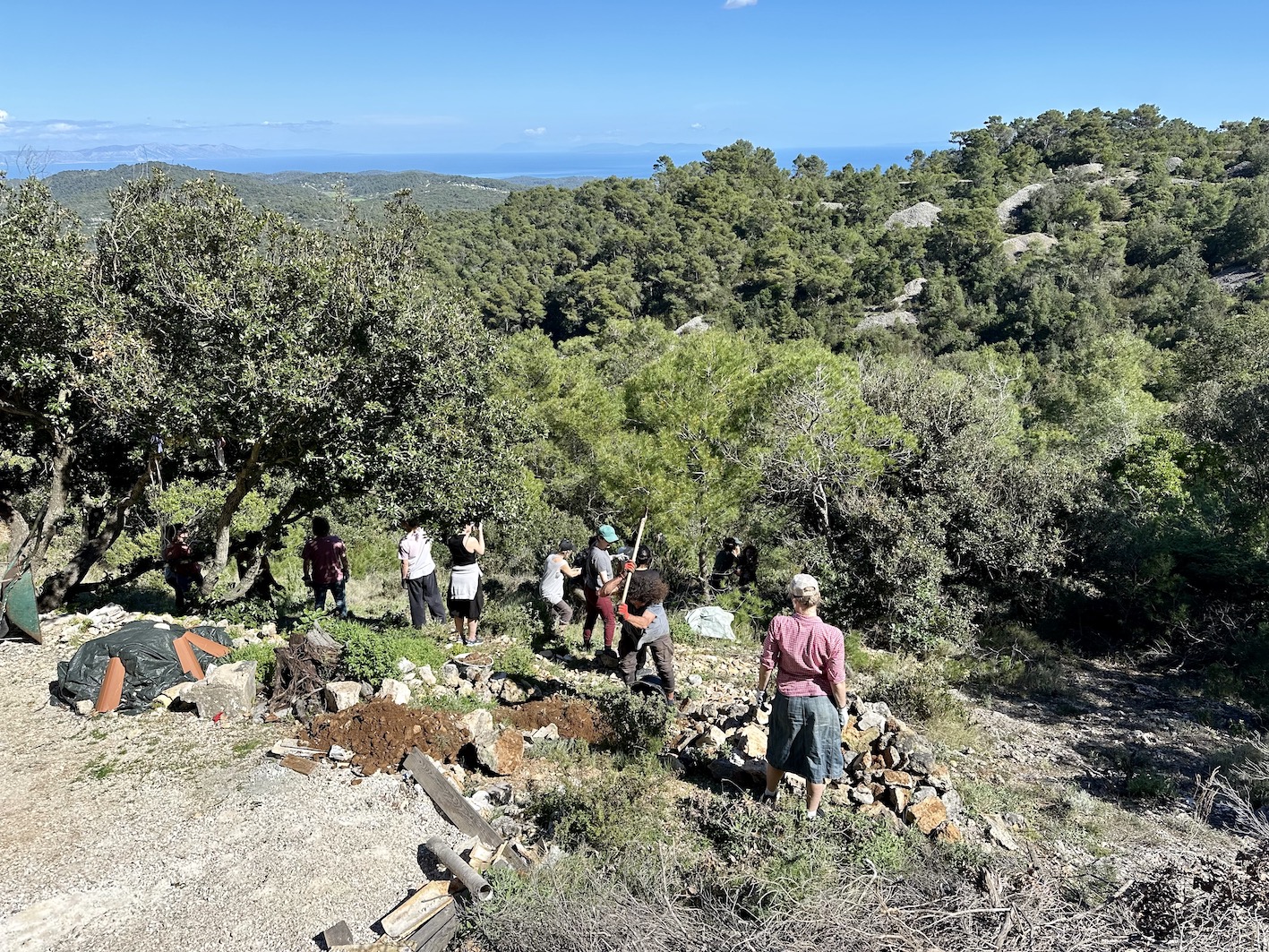
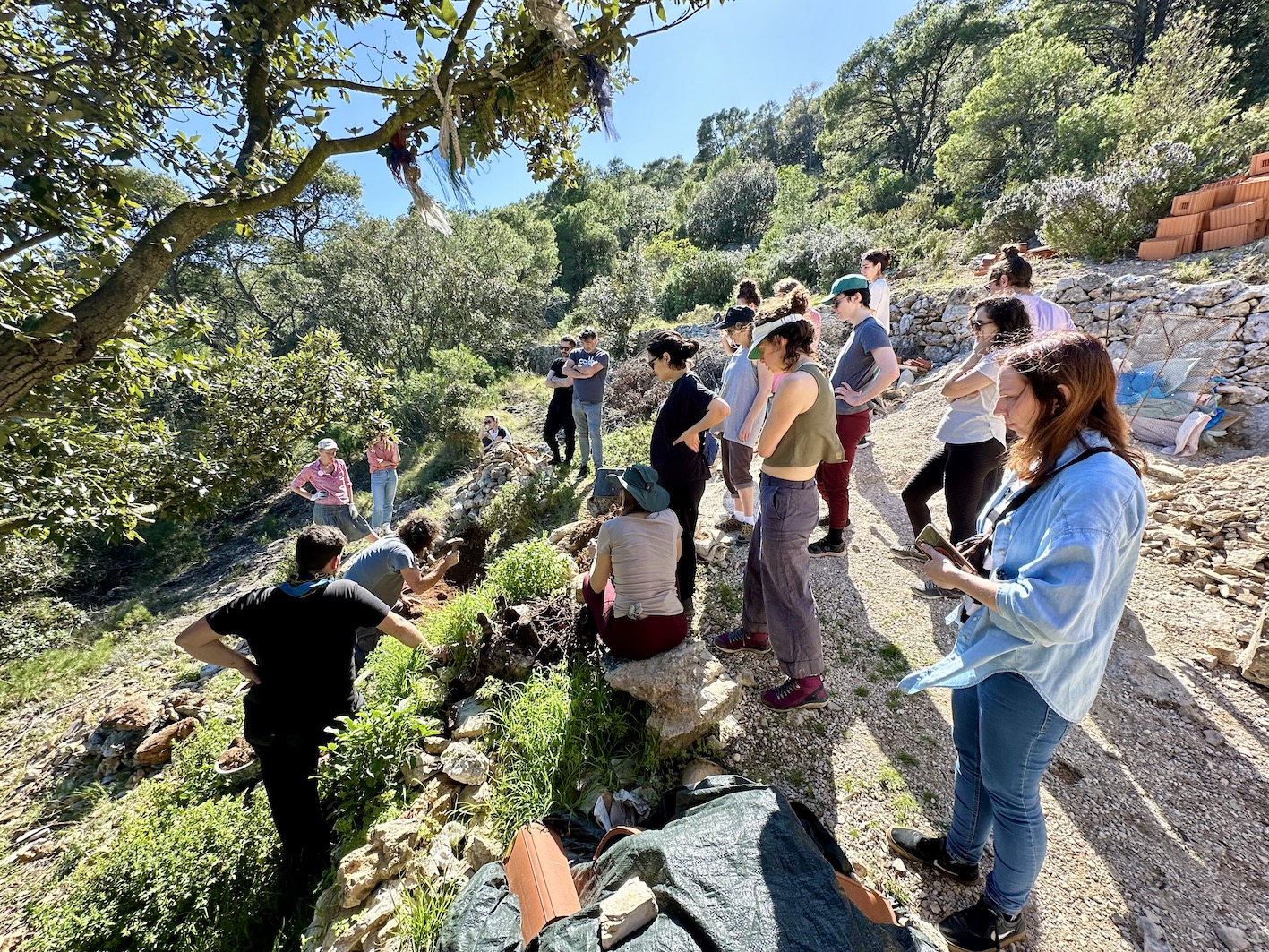
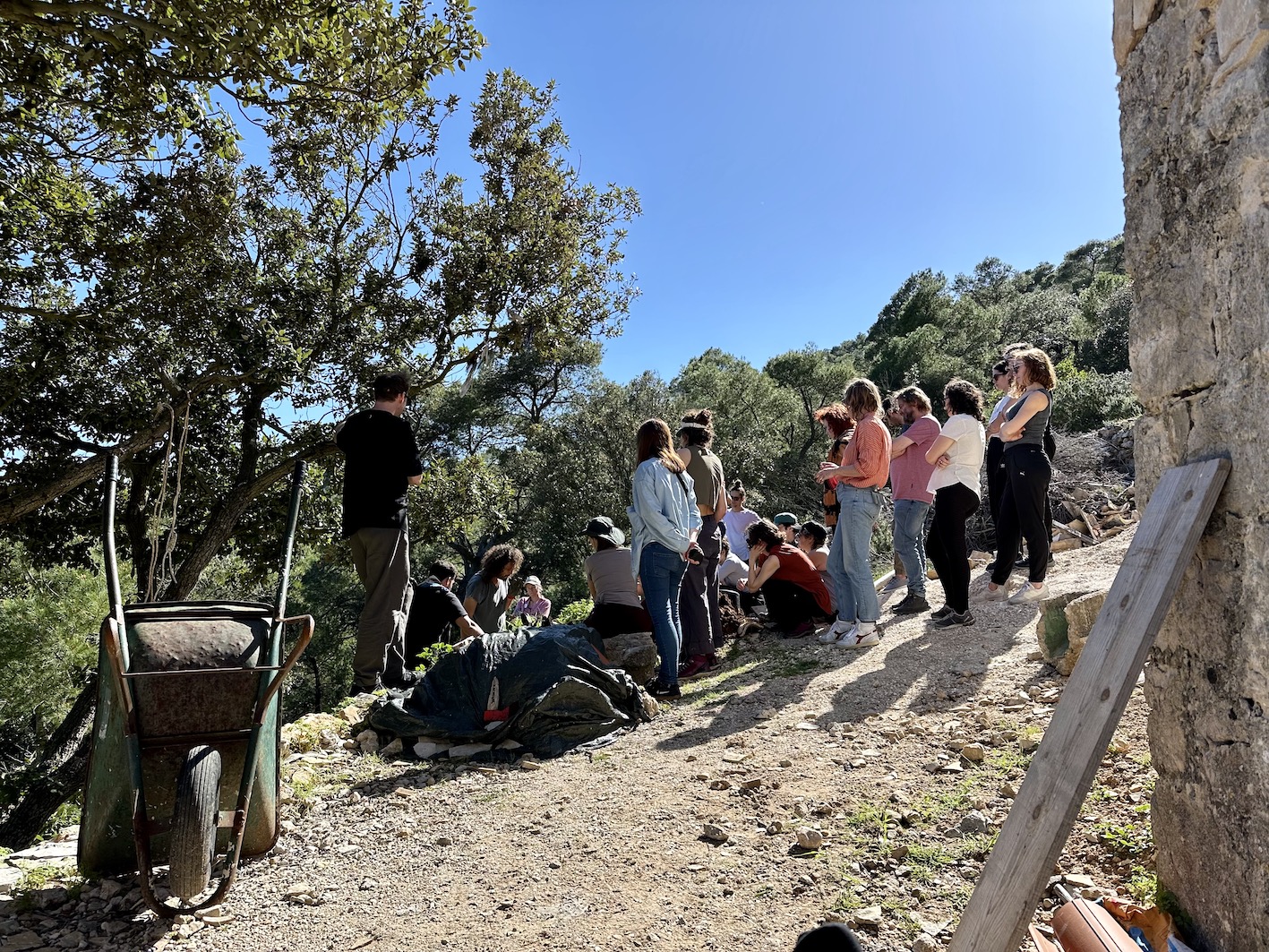
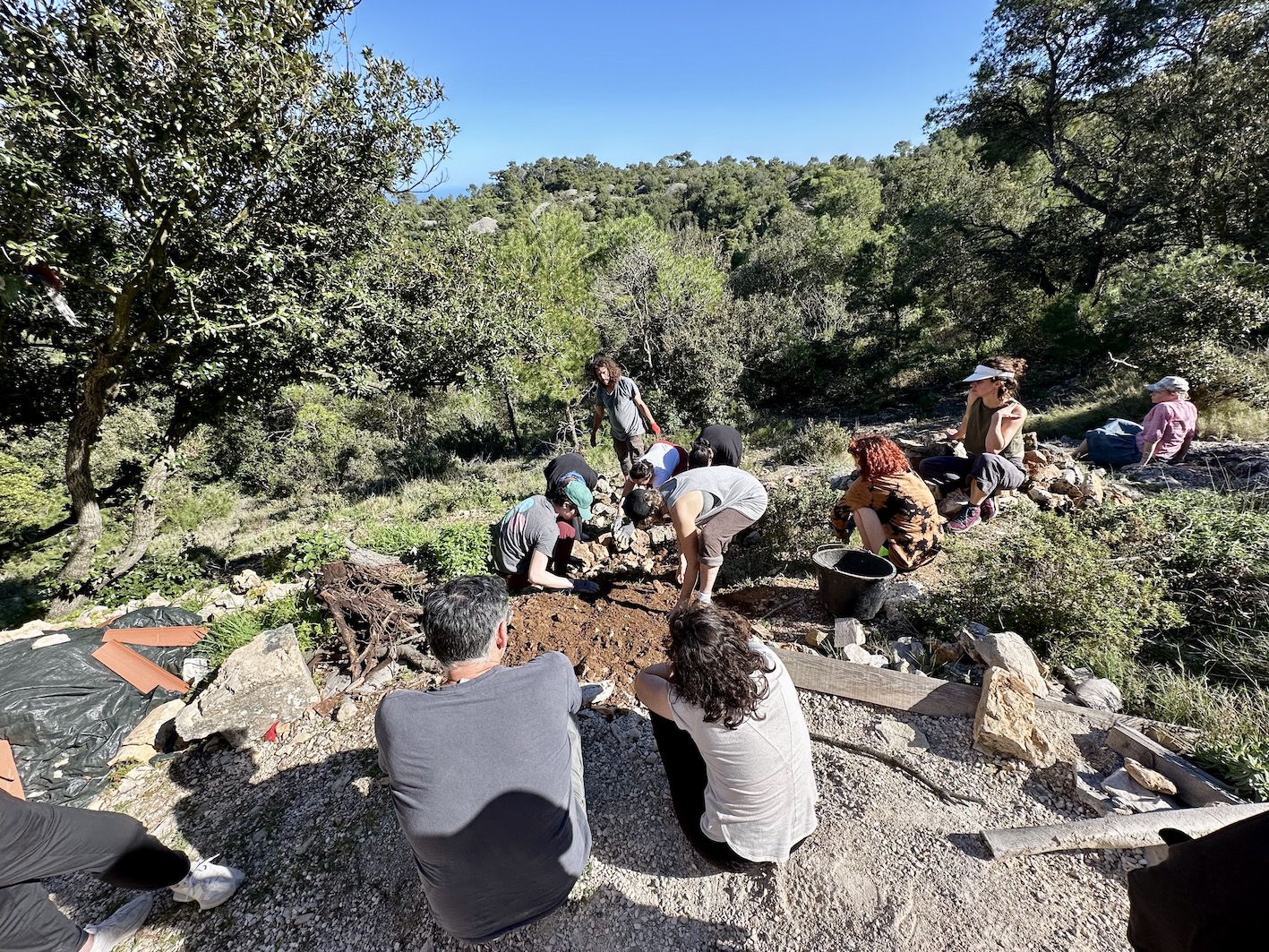
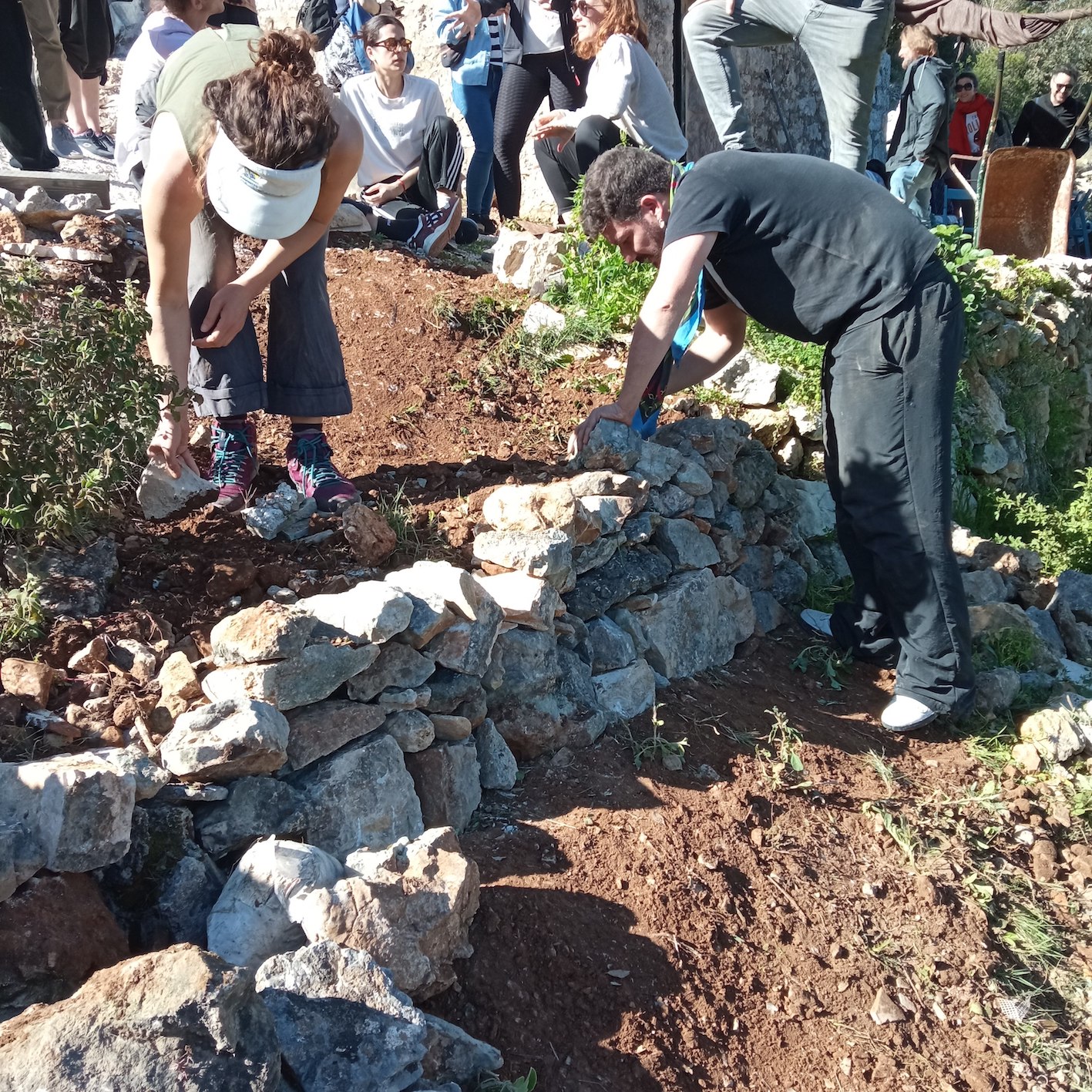
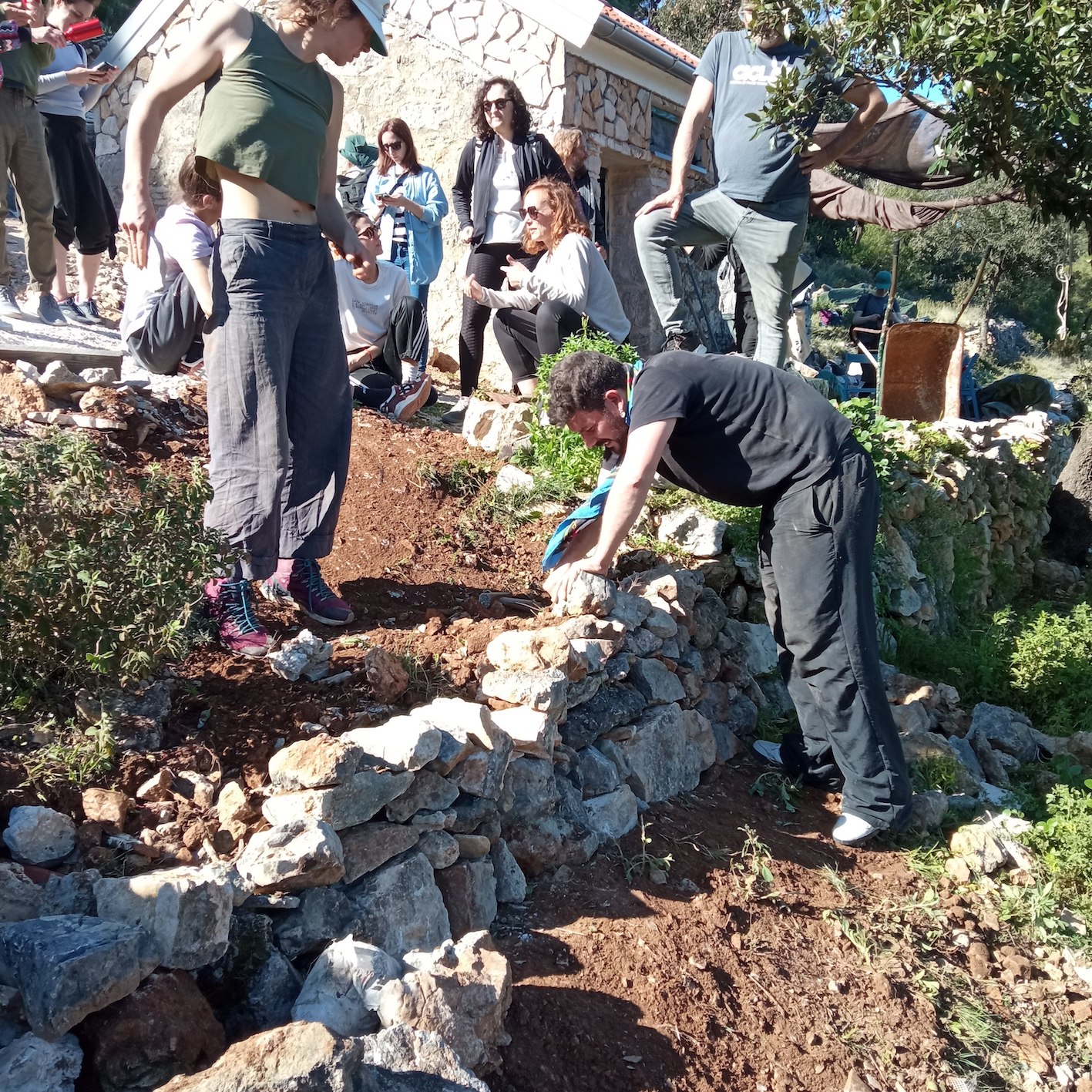
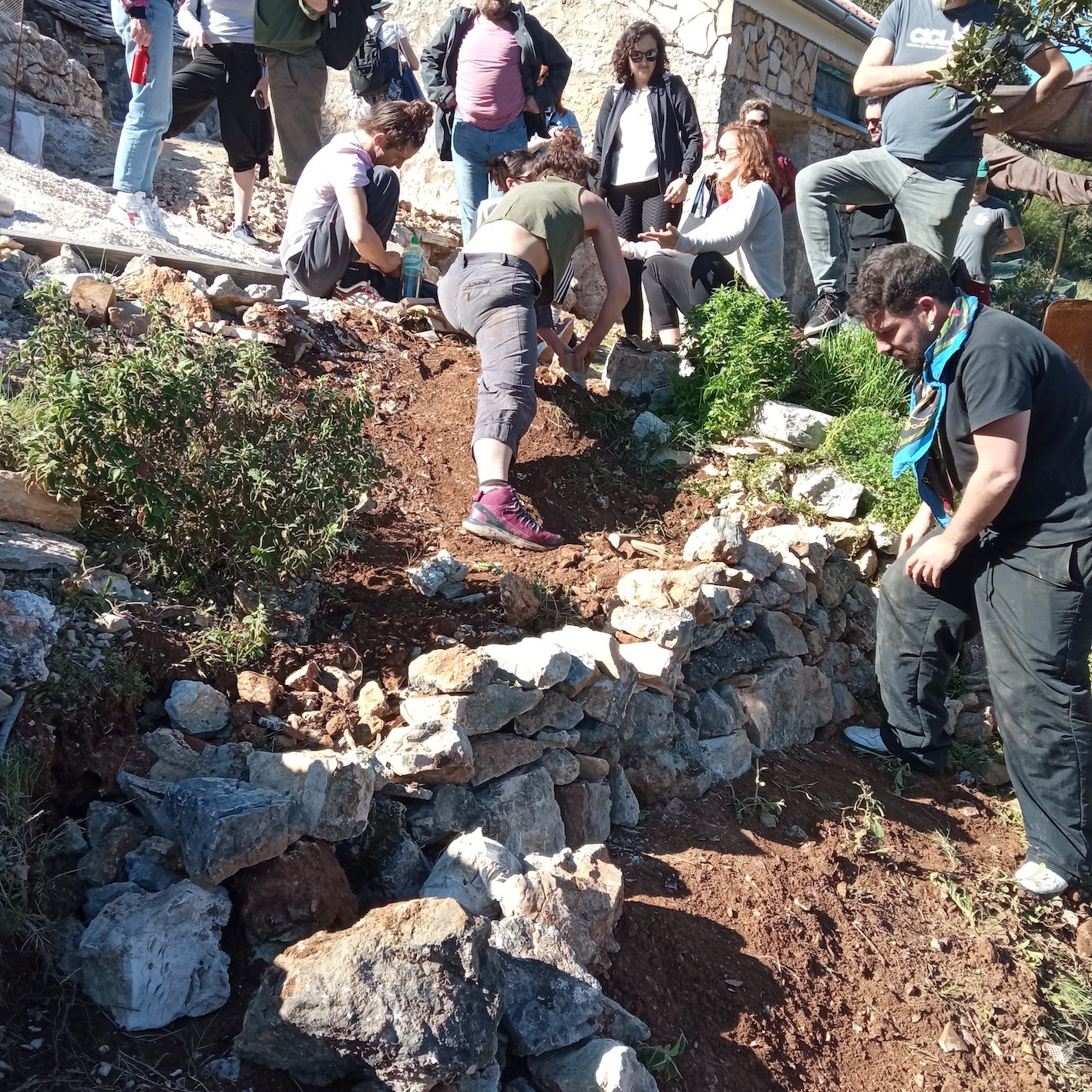
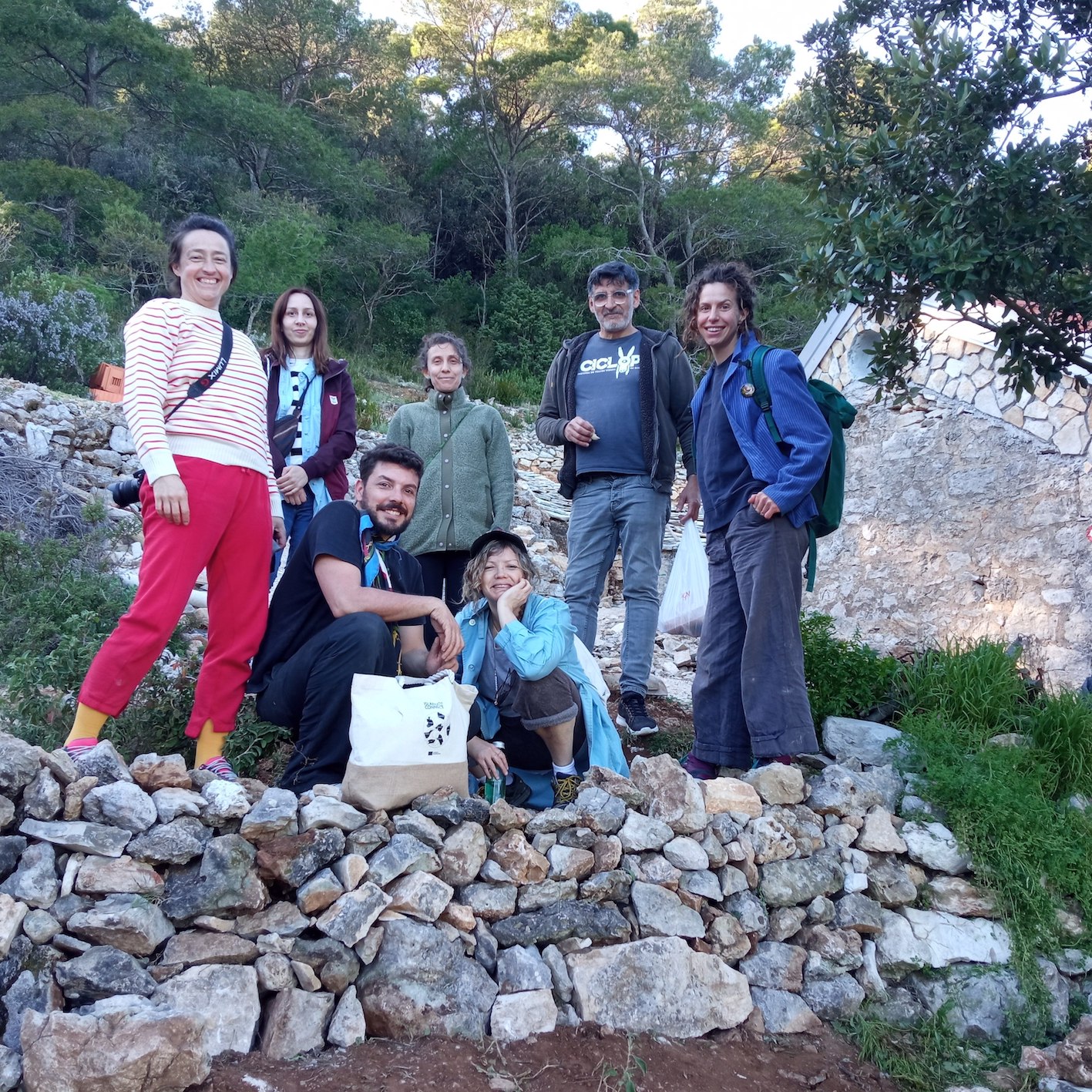
In early April, along with “Pomalo” and “Domino,” we organized a workshop on dry stone walling and sustainable development on the island of Vis. The art of building dry stone walls has been an integral part of the Mediterranean for centuries, even millennia, and has been included on the UNESCO list of Intangible Cultural Heritage of Humanity.
The workshop for restoring old dry stone walls was led by Igor Mataić, with a PhD in Civil Engineering, who tirelessly reconstructs and builds new dry stone walls on the island, and Tonči Darlić, a Komiža-based constructor specialized in stonework and a man of many talents.
The participants of the workshop were part of “Island Connect II,” a collaborative project of “Domino” and six partner organizations operating in the performing arts field. ISSA was visited by around 40 artists, producers, and curators from 10 countries who, guided by Igor and Tonči, helped us build a new dry stone wall in front of the School. We want to thank all participants and hope to see you again soon.
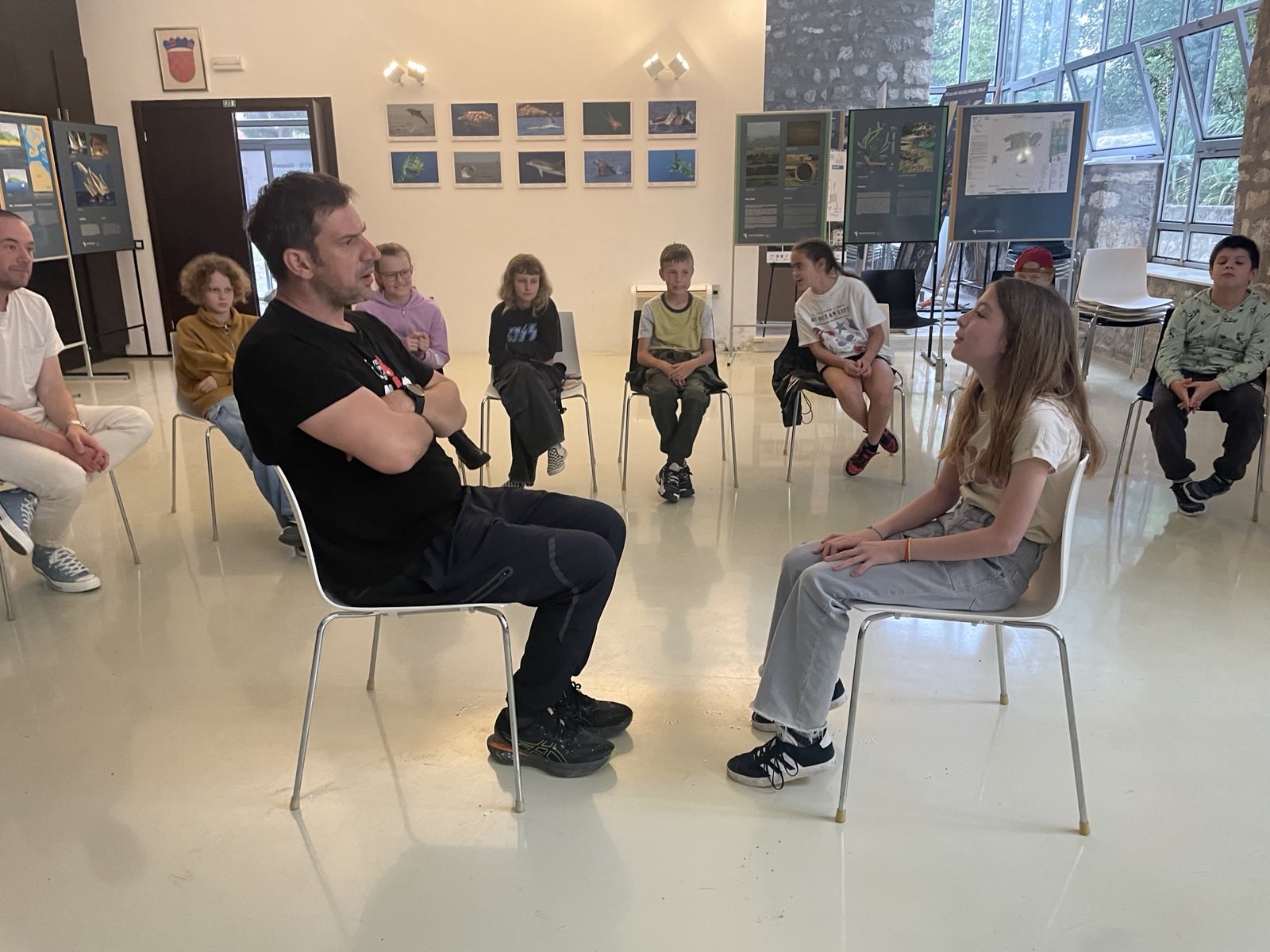
Otok Vis, a posebno Komiža, već su poslužili ne samo kao kulisa već i kao inspiracija ali i kao protagonisti legendarnih filmova kao što su Roko i Cicibela (1978) i Djetinjstvo i more (1974). U svibnju 2024 Komiža i njena djeca ponovo će igrati glavnu ulogu u radionici filma i glume na dječjem festivalu Kalanko od 2. do 5. svibnja. Cilj je, uz igru i eksperimentiranje, navođene uz usmjeravanje profesionalaca iz struke, osposobiti polaznike elementarnim znanjem i snalaženjem u naraciji, glumi i kreaciji zajedničke priče pred kamerama.
Radionica filma i glume otkrit će nepoznate priče o Komiži iz perspektive njezine djece, a istovremeno uputiti ih u tajne glumačkog i filmskog zanata. Djeca će imati priliku učiti i maštati zajedno s nagrađivanim glumcima Goranom Bogdanom i Jovanom Stojiljković, koji oboje imaju bogato iskustvo rada na filmu i u kazalištu, kao i rada s djecom. Zajedno s njima i djecom radit će legendarni filmski redatelj Želimir Žilnik, koji je s 27 godina osvojio Zlatnog medvjeda, u konkurenciji sa Godardom i Bunuelom, te kroz svoju karijeru snimao brojne nagrađivane filmove uglavnom s amaterima, djecom i ljudima koji nisu profesionalni glumci. Njima će se pridružiti filmski profesionalci Sarita Matijević i Branislav Klasnja.
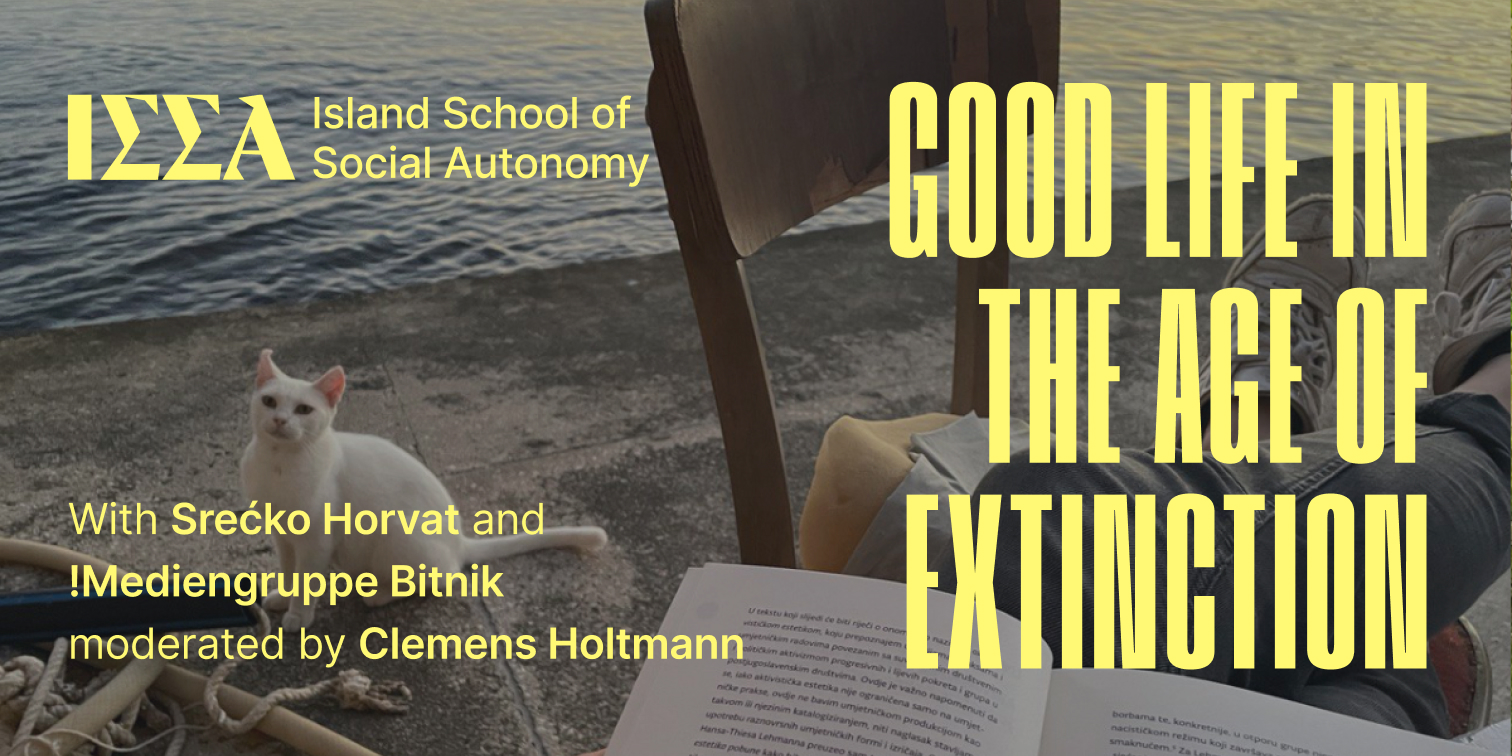
“ISSA – Good Life in the Age of Extinction” With Srećko Horvat and !Mediengruppe Bitnik moderated by Clemens Holtmann time: 6-7pm 16th of February 2024 /rosa Rosa-Luxemburg-Strasse 35 10178 Berlin https://www.panke.gallery/rosa/
On the 16th of February, some of the co-founders of ISSA will be in Berlin to present the work and ambitions of The Island School of Autonomy at the intimate space of /rosa. After the short presentation there will be a Q&A session, time for discussion and new collaborations.
Since /rosa has a limited number of seats please rsvp via email: issa@bitnik.org
An interview with Franco “Bifo” Berardi by Serena Tarabini originally published in Il Manifesto on December 9, 2023
In September, a hundred people met on the island of Vis, Croatia, to present the project of the Island School of Social Autonomy (ISSA), a school that would seek to answer the question of how to survive in the times of a planetary crisis that is leading humanity towards catastrophe.
Between philosophical theories and sustainable practices, the school will be pursuing knowledge that is useful for living better in the present when there is no glimpse of a better future. Does it amount to an army of nihilists?
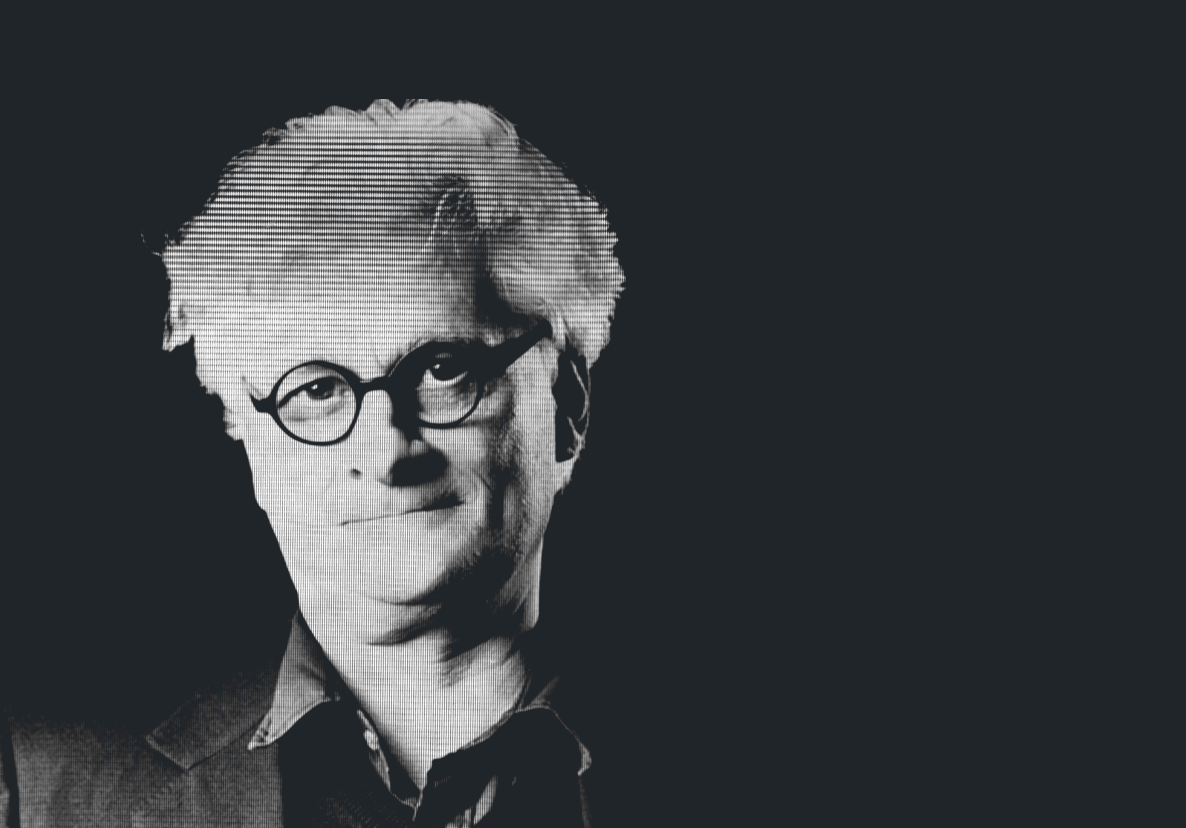
Writer and philosopher Franco “Bifo” Berardi is one of the founders of the project. The core idea is to defect: from weapons, war, exploitation, “hysterical heroism,” profit, consumption, progress. Defection from the limits and impositions of the global system of government is the thread that runs through his most recent writings.
Is the school meant to be a place of defection? What is the purpose of minding one’s own business and valuing other dimensions of existence – is it to throw a spanner in the works of the mechanism?
The project aims to start up research centers for knowledge that we currently lack. Knowledge that relates to our survival as individuals and as a community in environmental conditions changed to the point that we’re moving “like aliens on an unknown planet” (to quote Sabu Kosho from Japan, who wrote Radiation and Revolution, a book on the aftermath of the Fukushima event).
The political responses we’ve inherited from the 20th century are all flimsy. Political action, whether the (threadbare) one that calls itself left-wing or the (burgeoning) one that calls itself right-wing, are reduced to ineffective rituals: rabid proclamations, or attempts to prevent panic with old recipes whose validity has long since expired.
Perhaps we should start with the admission of a failure of political reason, and, without waiting any longer for anything to come from the decisions of politics, we should begin to ask: how will we live if the edifice of social civilization disintegrates, as seems to be happening? This is the question that the Island of Vis school is intended to answer; which, however, does not exist at this point. It is only a project.
We met up on Vis and we discussed these issues with about a hundred people, mostly from former Yugoslavia. We first visited the places of resistance and liberation of the island from the Nazi-Fascists. Then we reasoned about how we’re going to live now that the “Black Death,” defeated in 1945, is making a comeback everywhere.
As early as 1972, the Club of Rome report entitled “The Limits of Development” signaled that the dominant humanity had crossed a threshold. Since then, it has been a succession of endless alarms. What is the point of understanding reality if there is no will to change it?
Sometimes the will is not enough. In fact, if I may be honest, I think will is a cognitive faculty greatly overrated by moderns. The pride of the will, the romantic and futurist machismo heroism has led us to believe that politics can do everything, while actually it can do little, and now it can do almost nothing.
What frightens me about the reactionary wave is not the malice of particular wills, but the abysmal ignorance and the aggression that comes from powerlessness when the psychotic cult of power prevents you from coming to terms with reality. In the 20th century we have failed to accomplish the most important thing of all: to liberate technological knowledge from the dogma of economics. Cognitive work has failed to free itself from the dictatorship of profit and war. Here is where Oppenheimer is trapped, here is knowledge hostage to the military and financial system, here are electronic technologies functioning as an accelerant of exploitation.
It seems to me that this is first and foremost why the labor movement has lost. Alarms about the devastation of the environment are of little use when no one is willing to abandon the model based on unlimited growth, when the redistribution of wealth is culturally unacceptable. Now climate collapse is before everyone’s eyes (and being felt by everyone), but that changes nothing, because the profit of plastic producers is more important than the effect microplastics have on the body. And the defense of national borders is more important than the lives of those who were brought into the world without asking for it, and now serve as cannon fodder to be slaughtered in the name of liberal-fascism and the borders of the homeland.
The world debate is entirely focused on global warming, while all other environmental disasters caused by human beings are almost completely ignored, despite the fact that we’re getting sick and dying here and now. The only subject put forward to solve the crisis is the one who created it, namely capitalism with green seasoning. How far have environmentalists fallen into this trap?
The cycle of termination is beginning to emerge in all its complexity: capitalism has destroyed the environmental balance and initiated climatic and geological mutation. This mutation causes huge migrations, displacement of human masses predominantly from the South, which no longer have a livable territory, due to the growth of the North. The great migration is provoking a panic reaction that manifests itself as the epidemic of nationalist madness and war. War devastates territories and communities, reactivating the cycle of termination.
Green capitalism is a business destined to be short-lived, boosting the profits of the one percent of the white population who are preparing to emigrate to Mars with Elon Musk. And who would the environmentalists be? The German national-greens, Robert Habeck and Annelise Baerbock, these two distinguished gentlefolk who decided to reopen the coal mines in the name of the values of Western civilization, which would then be the values of Auschwitz and Hiroshima?
The only environmentalism that is intellectually up to the task is that of the kids who call themselves the Last Generation. Lastness is the condition in which we find ourselves, whatever politics does or does not do.
When we said “Socialisme ou barbarie” (Socialism or barbarism), we were not joking. Socialism lost, and I am not sure it could have made up for five centuries of colonialism and devastation anyway. In any case, there is no one left who wants to (much less would be able to) stop the termination of the human. There is an urgent need to recognize this, because only those who recognize that time is up will be able to reason about the possibility of collective survival for defecting autonomous communities.
In the context of defection, how do you see those who still take to the streets, whether for the environment, for jobs, for social inclusion? And who are mobilizing for the climate gripped by eco-anxiety?
Filling up the squares or occupying university faculties (as would be urgent to do) should not be understood as a mobilization of will to govern the ungovernable. The assembly meeting is for healing, it is for curing the mass psychosis that no psychiatrist is able to cure. In 1919 Sandor Ferenczi said that psychoanalysis could cure individual neurosis but not mass psychosis. I have always thought that collective mobilization does not serve to stop power, to overthrow or correct it, but it serves to consolidate solidarity and therefore autonomy.
Not even in 1968 did I think that we would win, that we would make a revolution and take power and teach old dogs new tricks. I never seriously thought that. I saw how it had turned out in the Soviet Union, and I thought, it’s better not to try it again, it would certainly end badly.
I’ve always thought – and I think more than ever today – that the demonstration, the occupation, the march are occasions to mobilize the energies of solidarity, of collective search. Today it is important to create opportunities for collective mobilization in order to experiment with frugal and solidarity-based forms of life, independent of the market, independent of the state. Organizing on a mass basis to defect from necro-capitalism: this is what many are beginning to do. Looking for lines of flight, niches of autonomous survival. Many are doing this: mass abandonment of work, desertion from war, desertion from the reproduction of humankind under inhuman conditions.
All the more so at this time, when the inhumanity of the human condition is particularly evident and frustration is a common condition more than ever?
I have come to the conclusion that we are facing the situation that will define our lives, the ethical and intellectual mark we will leave behind. Our grandchildren (if they even want to deal with us) will not be wondering what we did in 1968 or how we reacted in the face of the fascist attacks of the 1980s, or the kidnapping of Aldo Moro. Instead, they will ask: How did my grandmother act, what did my grandfather say and do, when they realized that in a place called Gaza a genocide was taking place not unlike that which from 1942 onward the Nazis perpetrated against Jews, Roma, homosexuals and communists, to name but one of the countless massacres that have dotted human history? I am aware that at the start of this current genocide was a pogrom, an act of atrocious violence. I have reflected and read a lot, and I feel a lot of pain and shame.
Essay by Mira Oklobdžija, originally published as “Škola autonomije na Visu”, Peščanik, 16.9.2023., after her visit to ISSA
Sailing towards Vis after a very long time, it was inevitable for me to wonder if this trip make sense. Would it be possible to accept the old space and new people, when the memory of those who are no more remains, woven into the fabric of the island and my own life? About 40 years ago in Komiža, at a time that still allowed for some optimism, in a country that would disappear only a few years later, a gathering of those who still hoped for positive political change was held. In contrast to the Korčula summer school (1964-1974), there were no internationally renowned academics, and the atmosphere exuded more of an activist charge than a desire to indulge in philosophical and sociological reflections. Rudi Supek, Milan Kangrga, Ivan Kuvačić, Miladin Životić, Nebojša Popov, Ljuba Tadić were present, to name just a few… Along with them, there was a motley crowd of change-seeking ‘leftists’, ‘anarcho-liberals’ and dissidents from all corners of Yugoslavia. But the school was banned after only two years. Society split up, and the country disintegrated. Forty years later, everyone listed above is no longer among the living. The others follow mostly separate life stories. I’m back in Vis, without them; reason enough for a justified dose of private nostalgia, regret for the past. But, as it turned out, nostalgia can be put in the right place if, despite the gloomy present, new energies are able to gather in the same place.
The Island School of Social Autonomy (ISSA) officially started its work in September 2023. It was conceived as a meeting place for all who strive for flights of imagination, learning, exchange of knowledge, energy, and experimentation of the type that traditional educational systems do not offer. What is offered by these systems, and accepted by inertia as meaningful is, as Ivan Illich said, propaganda that aims to convince us that we need society exactly as it is. The truth is somewhere else entirely; societies of agile consumers and the constant capitalist pursuit of ‘growth’ that we have today are exactly what we don’t need. The school on the island of Vis focuses on designing a way of living (not just surviving) in a time characterized by political, economic and climate crises, including the destruction/extinction of the world as we know it. The ambition is to develop a social experiment that can become a platform for thinking about a different world. Although the participants share the conviction that it is not possible to stop the avalanche that destroys everything without mercy, they do not advocate “romantic escapism”, “cultivating one’s own garden” or staring into one’s own navel. ISSA is conceived as a place of contemplation and action, facing reality but also dealing with social autonomy right now. The island of Vis was not chosen by chance, but as a place in the middle of the ocean that has not been bypassed by the most diverse crises, as a symbol of a possible archipelago, a region where festina lente (Mediterranean ‘slowly’ or ‘pomalo’) is a philosophy of life, and as a significant location of resistance to fascism.
The initiators are Srećko Horvat, Goran Bogdan, Nadežda Čačinović and numerous other philosophers, artists, actors, activists, poets and journalists from various countries, who are slowly but surely being joined by those who believe that autonomy as a form of social organization is more necessary today than ever. This means cooperation, compassion, solidarity, forms of self-government and expanding the network of connections with similar initiatives, wherever they are. The emphasis is on the need for responsibility (toward oneself and others) and care for those who need help, be it people, other animals, plants, places, or the Earth itself. Active members successfully combine the exchange of ideas, dissemination of information and physical work, with the motto “We build the school, the school builds us”. The seat is in a small house in the middle of the island, not easily accessible, and restored by the hard work of the “happy Sisyphus”, initiators and numerous friends. Solar panels are installed, a library is created, an archive is planned, and a symposium will be organized every year, which will include lectures, workshops, concerts, art exhibitions and work actions. The intention is also the revitalization of three hectares of neglected land through/and the creation of a Mediterranean garden in the forest. Preparations for the pirate radio station are well underway, and these are only the first steps; there is no shortage of ideas and plans for further actions. The ambitious plan, in the five-year period (or in several of them), is the construction of an amphitheatre on the school’s grounds that could accommodate up to 500 people. The intention is also to start a publishing house, with an emphasis on children’s books. In formulating their platform, the initiators list the questions that the school will deal with: What type of education do we need to secure the future? How to achieve a ‘good life’ amid the processes of destruction, and what does this ‘good life’ really mean? What forms of social organization and coexistence can we encourage because of, or despite, the imminent disaster?
On this occasion, the only “classical” lecture was given by Franco “Bifo” Berardi, an Italian Marxist of autonomist orientation, and also one of the initiators of ISSA. His vision of the future is not bright; he does not accept the false hope of a “happy ending” or a successful continuation of the journey. What he stands for is internationalism and solidarity with the courage to analyse the contemporary world and face the inevitable. The policies of the great powers, war and capitalism in conjunction with a new type of fascism and climate change must be re-examined without superficial embellishment. He insists that the term ‘climate crisis’ does not correspond to the state of affairs; you can get out of the crisis. According to him, a more accurate term is ‘collapse’. He sees the school as a search for alternatives whose only limit is imagination. It should be a long-term project of building bridges across the abyss of aggression and violence, in search of friendship and happiness, despite everything. The metaphor he uses is “happy Cassandra”, and she can become such only when she is freed from Apollo’s curse so that her prophecies can reach people. When asked by the audience how new generations could feel better in hopeless times, he answered with the words from Antonio Machado’s poem, “Caminante, no hay camino”: “Traveler, your footprints are the path and nothing more; Traveler, there is no path. The path is made by walking”. But some form of hope is certainly something that the youth expect from wise people. After the lecture, passing through the peaceful streets of Vis around midnight, I came across a dozen excited local visitors. One of them just articulated the basic problem: “It is easy for him to tell that there is no hope. He is old. There must be some hope.” The work of the school will certainly be interesting and turbulent, but that is also the intention. The necessary question that Berardi asks, namely “How did we get to this?”, must and will be combined with the search for an answer to the question “How to live?”
One of the initiators of this initiative, the philosopher Srećko Horvat, published the book “After the Apocalypse” two years ago, which deals with the analysis of issues that the school will be examining. At the beginning of the introduction, he quoted Kierkegaard: “A fire broke out behind the scenes in the theatre. A clown came out to warn the crowd; they thought it was a joke and applauded. He repeated the warning; the acclamation became even greater. I think the world will end just like that: with the general applause of smart people who believe it’s a joke.” Horvat thinks that the time where we had a choice between socialism and barbarism has passed, because our only alternative today is a profound new design of the world or disappearance. During the isolation due to the pandemic, most people aspired to return to “normal”, and the fact is that this “normal” was and remains a real problem. As far as climate change and nuclear threats are concerned, we are entering the realm of ‘supraliminality’, which is so far beyond our powers of understanding that we necessarily remain blinded by healthy eyes, as Gunther Anders said a long time ago.
With a lot of imagination, it is possible to carefully consider the weight of our moment if you are sitting in front of a stone house under construction, in good company, at the top of an island that looks like a timeless oasis of Mediterranean beauty at the end of summer. Horvat, finding a few minutes to take off his gloves and rest after a second round of wheeling sandbags along a steep path, tells me that ambition is not hoping that the problems around us will lose their strength. The idea of the school is to combine theory and practice, work together, create friendships and develop solidarity while advocating for alternative forms of education. They should be aimed both at art and at the development of a different narrative based on demystification or translation into understandable language of presentations of scientific fact that no one fully understands. The path leading to the stone house is challenging, but it exists. The other paths, in the sphere of ideas, creativity and solidarity, will be created while walking.
It is believed that the Peripatetics, like Aristotle, thought better while walking. During their early youth, Australian aborigines practised a months-long ritual journey, known as a “walkabout”, the goal of which was the transition to the world of adults. In Belgrade and other cities of Serbia, political protests known as “walks” have been held for decades. Movement is a necessity of life, in the same way that the winding line on the cardiogram means that we are still breathing. In today’s world, it can keep at bay psychological if not always physical pollution that threatens from all sides. How, in which direction, and with what goal in mind someone will walk depends on personal choice. During the four days of the inauguration of the ISSA (7-11 September), the group did three walks together. The first tour, led by Bruna Bebić and Srećko Horvat, moved along the places important for the anti-fascist struggle of the inhabitants of Komiža, in addition to the remaining monuments (those that were not removed during the nineties out of some rather crazy reasons, not only on Vis, but throughout Croatia). The following day, artists and researchers Selena Savić, Goran Savičević and members of the !Mediengruppe Bitnik Goran Smoljo and Carmen Weisskopf took the participants of the school, under the banners, on a walk through the town of Vis, called “Tour of one star”. The ‘one star’ is an allusion to bad reviews of a place, in this case Vis, publicized through Google, indicative of the ability of large global companies to describe something they don’t know and thereby influence those who believe them, as well as the life of those who depend on tourism for their livelihood. A comprehensive report was published in “Jutarnji list”. On the last day, a walk along narrow path heading uphill was organized, leading to a site near Tito’s Cave, where the centre of the school is located. Those more physically able started construction work, and everyone socialized, meeting new people worth knowing, planning future actions, learning about the possibilities of a pirate radio station… The youngest active participant was one-and-a-half- years old. A day to remember and generate energy which can enable a more human view, even in the dark future.
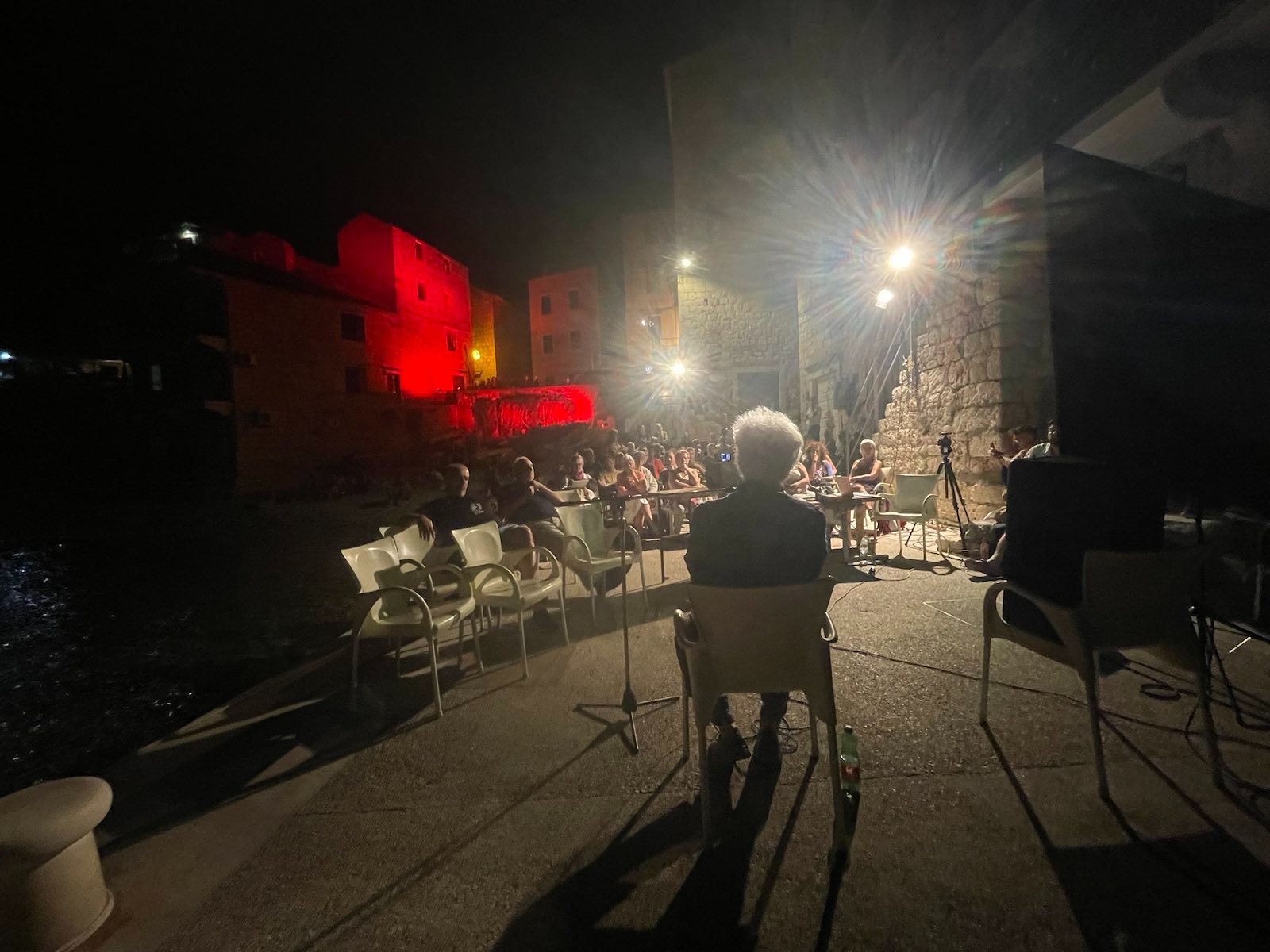
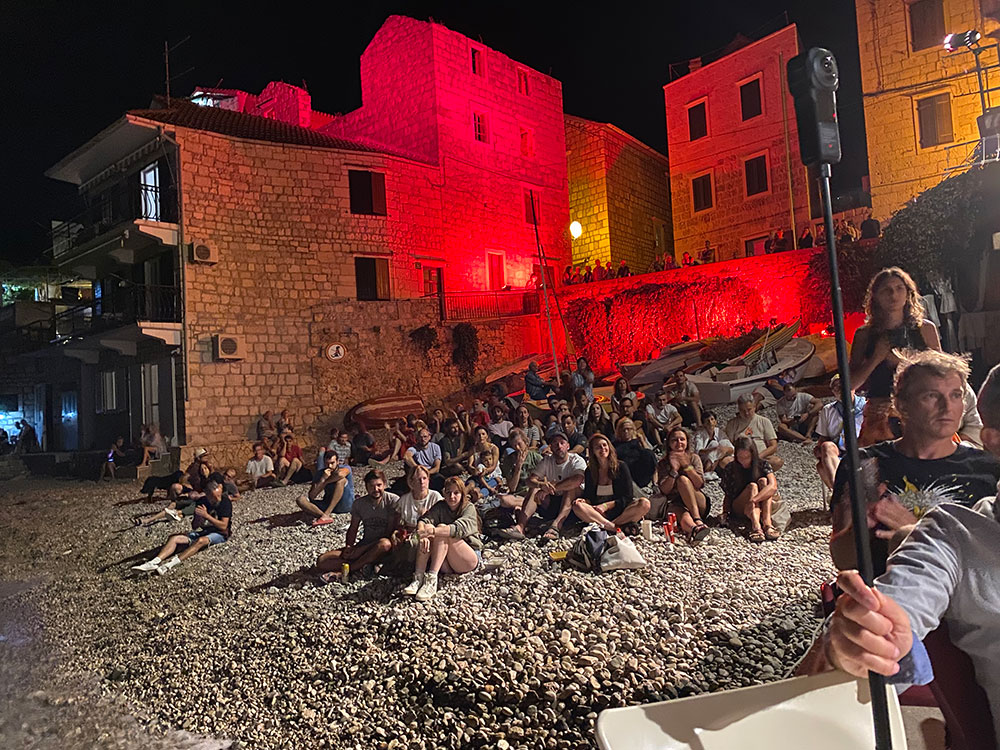
On 10 September, the 18th anniversary of the liberation of Vis from fascism, a celebration was held on a small beach in Komiža, attended by potential members, locals and tourists in addition to the already active participants of ISSA. Actors Goran Bogdan and Milivoj Beader read poems of Brecht, Kavafis and Mayakovsky, followed by those by Desanka Maksimović, Vesna Parun, Izet Sarajlić, Ivan Goran Kovačić and Jure Kaštelan. The local poet Pepe Kalafat spoke his poems, and we heard a lot about the days of war, people that should not be forgotten, challenges and struggles. There was music (for example “Bella ciao” performed by Luka Nižetić, joined by everyone from the audience who knows the words). Friends appeared with beans for everyone, in traditional and vegetarian versions. Of course, the organization, technical assistance, performances, cooking and cleaning later were the result of solidarity and volunteer work with the support of the City of Komiža and the Tourist Board. Informal self-organization was fully expressed. Autonomy makes as much sense today as it did yesterday, or even more. The alternative is to wait forever for someone else to come up with an idea, suggest, change, or impose something. ISSA is a kind of search for utopia, regardless of the fact that we live in times where it is much easier to imagine dystopias. But what is easier is usually not better.
Ploveći prema Visu poslije dugog vremena izbivanja bilo mi je neizbježno pitati se ima li to putovanje smisla. Hoće li biti moguće prihvatiti stari prostor i nove ljude, kad više nema onih koji su u sjećanju ostali kao uspomena utkana u tkivo otoka i vlastitog života. Prije četrdesetak godina u Komiži, u vremenu koje je još davalo prostora nekom optimizmu, u zemlji koja će nestati samo nekoliko godina kasnije, održan je skup onih koji su se još uvijek nadali pozitivnim političkim promjenama. Za razliku od Korčulanske ljetne škole (1964-1974) nije bilo svjetski poznatih akademika iz drugih zemalja, a atmosfera je odisala više aktivističkim nabojem nego željom ka davanju obola filozofskim i sociološkim promišljanjima. Bili su prisutni, da spomenem samo neke, Rudi Supek, Milan Kangrga, Ivan Kuvačić, Miladin Životić, Nebojša Popov, Ljuba Tadić… Uz njih, tu se našla šarolika gomila promjene željnih ‘ljevičara’, ‘anarho-liberala’ i disidenata iz svih kutaka Jugoslavije. No škola je zabranjena poslije samo dvije godine. Društvo se razišlo, zemlje više nema. Četrdeset godina kasnije svi ovdje navedeni imenom više nisu među živima. Ostali slijede uglavnom odvojene životne priče. Ja sam ponovo na Visu, bez njih. Dovoljno za opravdanu dozu privatne nostalgije, žala za prošlošću. Ali, kako se pokazalo, nostalgiju se može staviti na pravo mjesto, ako se nove energije, uprkos našim sumornim vremenima, ipak uspiju okupiti i to na istom mjestu.
Škola autonomije (Island School of Social Autonomy) ovog je septembra oficijelno započela sa radom. Zamišljena je kao mjesto okupljanja za sve koji teže uzletima mašte, učenju, razmjeni znanja, energije i eksperimentiranju onog tipa koje tradicionalni obrazovni sistemi ne nude. Ono što je od strane tih sistema ponuđeno, a po inerciji se prihvaća kao smisleno je, kao što reče Ivan Illich, propagiranje koje ima za cilj ubijediti nas da trebamo društvo upravo takvo kakvo jest. Istina je negdje posve drugdje; društva agilnih potrošača i neprestane kapitalističke težnje za ‘rastom’ kakva danas imamo su upravo ono što ne trebamo. Škola na Visu se fokusira na osmišljavanje načina življenja (ne samo preživljavanja) u vremenu koje je karakterizirano krizama na političkom, ekonomskom i klimatskom nivou, uključujući uništenje/izumiranje svijeta kakvog znamo. Ambicija je razvijanje društvenog eksperimenta koji može postati platforma za promišljanje drugačijeg svijeta. Iako učesnici dijele ubjeđenje da nije moguće zaustaviti uglavnom od strane ljudi pokrenutu lavinu koja bez pardona uništava sve, ne zagovaraju „romantični eskapizam“, „bavljenje vlastitim vrtom“ ili udubljenost u vlastiti pupak. ISSA je zamišljena kao mjesto kontemplacije i akcije, suočavanja sa stvarnošću ali i bavljenja socijalnom autonomijom upravo sada. Otok Vis nije izabran slučajno već kao mjesto usred mora koje najraznovrsnije krize nisu zaobilazile, kao simbol mogućeg arhipelaga, područje na kojem je festina lente (mediteransko ‘pomalo’ ili polako) životna filozofija, te kao značajna lokacija otpora fašizmu.
Inicijatori su Srećko Horvat, Goran Bogdan, Nadežda Čačinović i brojni drugi filozofi, umjetnici, glumci, aktivisti, pjesnici, novinari iz raznih zemalja, kojima se polako ali sigurno pridružuju oni koji smatraju da je autonomija kao oblik društvene organizacije danas potrebnija nego ikad. Pod tim se podrazumijeva suradnja, suosjećanje, solidarnost, oblici samouprave i širenje mreže povezivanja sa sličnim inicijativama, ma gdje bile. Težište je na potrebi za odgovornošću (prema sebi i drugima) i brizi za one kojima je pomoć potrebna, bili to ljudi, ostale životinje, biljke, mjesta ili Zemlja sama. Do sada aktivni članovi uspješno kombiniraju razmjene ideja, širenje informacija i fizički rad, uz moto „Mi gradimo školu, škola gradi nas“. Sjedište je u maloj kući usred otoka, ne lako pristupačnoj i obnavljanoj napornim radom „sretnih Sizifa“, inicijatora i brojnih prijatelja. Stavljaju se solarni paneli, kreira biblioteka, planira arhiv, a svake godine će biti organiziran simpozij koji će obuhvaćati predavanja, radionice, koncerte, umjetničke izložbe i radne akcije. Intencija je i revitalizacija 3 hektara napuštenog zemljišta, stvaranje Mediteranskog vrta u šumi. Pripreme za piratsku radio stanicu su uvelike u toku, a to sve su tek prvi koraci; ne nedostaje ideja i planova za daljnje akcije. Ambiciozna nakana, u petoljetci (ili u nekoliko njih), je izgradnja amfiteatra na zemljištu Škole koji bi mogao primiti do 500 ljudi. Namjera je i pokretanje izdavaštva, sa naglaskom na dječje knjige. Formulirajući svoju platformu inicijatori navode pitanja kojima će se Škola baviti: Kakav tip obrazovanja nam je potreban da osiguramo budućnost? Kako postići ‘dobar život’ usred procesa uništenja, i što to ‘dobar život’ u stvari znači? Koje oblike društvene organizacije i koegzistencije možemo poticati zbog, ili uprkos, neminovne katastrofe?
Jedino ‘klasično’ predavanje je ovom prilikom održao talijanski marksist autonomističke orijentacije i također jedan od inicijatora Škole, Franco ‘Bifo’ Berardi. Njegovo viđenje budućnosti nije svijetlo, ne prihvaća lažnu nadu o ‘sretnom kraju’ ili uspešnom nastavku puta. Ono za što se zalaže je internacionalizam i solidarnost uz hrabrost da se analizira suvremeni svijet i pogleda u oči neizbježnom. Politike velikih sila, ratovi, kapitalizam u sprezi sa novim tipom fašizma i klimatske promjene moraju se preispitivati bez površnog uljepšavanja. Inzistira da izraz ‘klimatska kriza’ ne odgovara stanju stvari; iz krize se može izaći. Po njemu, preciznija riječ je ‘kolaps’. Školu vidi kao traganje za alternativama kojima je granica jedino mašta. Ona bi trebala biti dugotrajni projekt građenja mostova preko ambisa agresije i nasilja, a u potrazi za prijateljstvom i srećom, uprkos svemu. Metafora koju koristi je „sretna Kasandra“, a takva ona može postati jedino kad se oslobodi Apolonove kletve pa njena proročanstva budu mogla dospjeti do ljudi. Na pitanje iz publike na koji način bi se nove generacije mogle osjećati bolje u beznadnim vremenima, odgovorio je riječima iz pjesme Antonia Machada, „Caminante, no hay camino“: „Putniče, tvoji koraci su jedini put, ništa više. Putniče, staza ne postoji; ti stvaraš vlastitu stazu, hodajući.“ Ali neki oblik nade je zasigurno ipak nešto što omladina očekuje od mudrih ljudi. Poslije predavanja, prolazeći mirnim kalama Visa oko ponoći, naišla sam na desetak uzbuđenih lokalnih posjetitelja. Jedan od njih je upravo artikulirao osnovni problem: „Lako je njemu pričat da nema nade. On je star. Mora biti neka nada.“ Rad škole će zasigurno biti zanimljiv i buran, no to je i namjera. Pitanje koje Berardi postavlja kao nužno – „Kako smo do ovoga došli?“ mora i bit će kombinirano sa traženjem odgovora na pitanje „Kako živjeti?“.
Jedan od pokretača ove inicijative, filozof Srećko Horvat, objavio je pred dvije godine knjigu „After the Apocalypse“ koja se bavi analizom pitanja kojima će se i Škola baviti. Na početku uvoda citira Kierkegaarda: „Iza scene u teatru je buknula vatra. Klaun je izašao da upozori publiku; oni su mislili da je u pitanju šala i pljeskali. Ponovio je upozorenje; aklamacija je postala još veća. Mislim da će svijet upravo tako završiti: uz opći aplauz pametnjakovića koji vjeruju da se radi o šali.“ A Horvat misli da je prošlo vrijeme kada smo mogli birati između socijalizma i barbarstva jer su naše jedine alternative danas dubinsko novo osmišljavanje svijeta ili iščeznuće. Tokom izolacije zbog pandemije većina je ljudi težila povratku „u normalu“, a stvar je upravo u tome sto je ta „normala“ bila i ostala pravi problem. A što se klimatskih promjena i nuklearnih prijetnji tiče, ulazimo u sferu ‘supraliminalnosti’ koja je toliko iznad naših moći razumijevanja da nužno ostajemo slijepi kraj zdravih očiju, o čemu je odavno govorio Gunther Anders.
Tek je uz mnogo mašte moguće jasno zamisliti težinu našeg trenutka ako se sjedi pred kamenom kućom u izgradnji, u dobrom društvu, na vrhu otoka koji izgleda poput bezvremenske oaze mediteranske ljepote krajem ljeta. Horvat, našavši koju minutu da skine rukavice i odmori se poslije druge ture voženja vreća pijeska po stazi koja to čini vrlo napornim poslom, kaže mi da ambicija nije gajenje nade da će problemi koji su oko nas izgubiti na snazi. Ideja Škole je spojiti teoriju i praksu, raditi zajedno, stvarati prijateljstva, razvijati solidarnost, uz zalaganje za alternativne forme obrazovanja. One bi trebale biti usmjerene kako na umjetnost tako i na drugačiji narativ baziran na demistifikaciji ili prevođenju na razumnjiv jezik prezentacija znanstvenih činjenica koje nitko do kraja ne razumije. Staza prema kamenoj kući je zahtjevna ali postoji. One druge, u sferi ideja, kreativnosti i solidarnosti, će se kreirati tokom hodanja.
Peripatetici su, vjeruje se, poput Aristotela bolje razmišljali hodajući. Australijski starosjedioci su u vremenu rane mladosti upražnjavali mjesecima dug ritualni put, poznat kao „walkabout“, čiji je cilj bio prijelaz u svijet odraslih. U Beogradu i drugim gradovima Srbije desetcima godina se održavaju politički protesti poznati kao „šetnje“. Kretanje je životna nužnost, na isti način kao sto vijuganje linije na kardiogramu znači da još dišemo. U današnjem svijetu ono može držati na odstojanju bar psihičko ako ne uvijek fizičko zagađenje koje prijeti sa svih strana. Kako, u kojem pravcu i sa kojim ciljem će netko kročiti zavisi o ličnom izboru. Tokom četiri dana inauguracije Škole (od 7. do 11. septembra) šetalo se u grupi tri puta. Prva tura, koju su vodili Bruna Bebić i Srećko Horvat, kretala se uz mjesta važna za antifašističku borbu stanovnika Komiže, uz preostale spomenike, one koji tokom devedesetih nisu uklonjeni iz nekih prilično suludih razloga (ne samo na Visu, već diljem Hrvatske). Slijedećeg dana, umjetnici i istraživači Selena Savić, Gordan Savičević i članovi !Mediengruppe Bitnik Domagoj Smoljo i Carmen Weisskopf poveli su, sve uz transparente, učesnike Škole na šetnju kroz grad Vis, nazvanu „Tura jedne zvjezdice“. Bazirana je na lošim recenzijama nekog mjesta, u ovom slučaju Visa, javno objavljanim preko Google-a, a koje ukazuju na mogućnost velikih svjetskih kompanija da opisuju nešto što u stvari ne poznaju i time utječu na one koji im lako vjeruju, kao i na život onih koji od turizma žive. Opširan izvještaj je objavljen u Jutarnjem listu. Poslijednjeg dana je organizirana šetnja po uskim stazama uzbrdo, do lokacije u blizini Titove špilje, na kojoj je smješteno središte Škole. Oni fizički sposobniji prionuli su radnoj akciji, a svi druženju, upoznavanju novih ljudi koje vrijedi znati, planiranju budućih akcija, učenju o mogućnostima piratske radio stanice… Najmlađa aktivna sudionica ima godinu i po. Dan za sjećanje i buđenje energije koja nudi ljudskiji pogled pa makar i u mračnu budućnost.
Na osamdesetu godišnjicu oslobođenja Visa od fašizma, 10. septembra održana je na maloj plaži u Komiži proslava kojoj su, uz već aktivne učesnike Škole, prisustvovali njeni potencijalni članovi, mještani, turisti. Glumci Goran Bogdan, Jovana Stojiljković i Milivoj Beader čitali su pjesme Brechta, Kavafisa i Majakovskog, zatim Desanke Maksimović, Vesne Parun, Izeta Sarajlića, Ivana Gorana Kovačića, Jure Kaštelana… Svoje je pjesme govorio lokalni pjesnik Pepe Kalafot, a čulo se mnogo o danima rata, ljudima koje ne treba zaboraviti, izazovima i borbi. Bilo je muzike (Bella ciao, u izvedbi Luke Nižetića kojem su se pridružili svi iz publike koji znaju riječi, nije izostala). Prijatelji su se pojavili sa grahom za sve, u tradicionalnoj i vegetarijanskoj varijanti. Naravno, organizacija, tehnička pomoć, izvedbe, kuhanje i kasnije čišćenje su bili rezultat solidarnog, volonterskog rada uz podršku Grada Komiže i Turističke zajednice. Neformalno samoorganiziranje se u potpunosti iskazalo. Autonomija ima smisla, danas koliko i jučer, ili još više. Alternativa je vječno čekanje da netko drugi nešto smisli, predloži, promijeni ili naredi. ISSA je svojevrsno traženje utopije bez obzira sto živimo u vremenima u kojima je mnogo lakše zamišljati distopije. No ono sto je lakše uglavnom nije bolje.
Article that mentions ISSA by Brian Sholis, writer and editor based in Toronto, published in the Frontier Magazine under the title “Way Out There – and Everywhere”
Last weekend, on Vis, a small Croatian island in the Adriatic Sea, Italian philosopher Franco Berardi helped inaugurate the Island School of Social Autonomy with a lecture titled “How Will We Live?” I’ve been following along as the school’s co-founders painstakingly renovate an old stone house in the hills above Komiža and reading with interest as they publish essays that cite many of the culture and education critics I most admire. I’m also intrigued because its list of cofounders includes not only philosophers, theorists, artists, and poets, but also actor-activists like Gael García Bernal and Pamela Anderson. That kind of support—both in visibility and funding—can give experiments like this one the momentum it needs to stay afloat.
The founders make the distinction between education and learning, noting, correctly, that learning mostly happens outside the formal institutions we have for education—and that the kinds of things taught in school may not serve us well for an “age of extinction.” So the ISSA should be “a place that imagines, experiments with, and cultivates forms of knowledge production and sharing that go beyond traditional notions of education and its purpose.” Its principles include “no curriculum,” “no quantification,” “play,” “hospitality,” and, “Pomalo!”
On Vis, that last term, they suggest, “is both a greeting meaning ‘take it slow’ and an island philosophy of how things can get properly done or how to react in utter crisis.” They’ve chosen to locate the project on the island in part for that attitude, how it refuses the orthodoxy “time is money,” and for the island’s antifascist and other histories. “Similar to ISSA itself, the island of Vis embodies an essential dialectic relationship between autonomy and dependency, nature and society, local and global. For ISSA, it is not an either-or situation.”
And what about that goal, social autonomy? “We perceive social autonomy as the ability of individuals to function as cooperative group members, engaging in communal self-governance while being aware of the interconnectedness and interdependence of communities within broader networks (or archipelagoes) of human and non-human life-organization.”
ISSA (..) is a model of rigor and camaraderie, a beacon shining from the (quite literal) hills.”
“Ne idite tamo. Odite na Hvar”, jedan je od transparenata koji su otočani i turisti u petak mogli zamijetiti na raznim viškim lokalitetima. I dok su neki pomislili da se radi o nekom prosvjedu, nositelji bannera na umu su imali sasvim drugi cilj. Kako bi bacili svjetlo na potencijalne probleme uzrokovane negativnim recenzijama s Googlea i Trip Advisora, umjetnički kolektiv !Mediengruppe Bitnik iz Škole autonomije (Island School of Social Autonomy-ISSA suosnovali su Srećko Horvat, Goran Bogdan, Nadežda Čačinović i brojni drugi) u suradnji s umjetnicima te istraživačima Selenom Savić i Gordanom Savičićem organizirao je turu ‘1 zvjezdice‘, to jest, obilazak na Googleu i Trip Advisoru loše ocjenjenih mjesta diljem Visa.
“Provodili smo vrijeme na jednoj plaži na Visu i uživali. Promislili smo gdje bismo poslije toga mogli otići, tražili smo neko lijepo, opušteno mjesto i tada smo naišli na negativne recenzije mjesta koja u stvarnosti izgledaju fantastično. Zapitali smo se što ljudi uopće očekuju od tih mjesta i kako se u ekonomiji recenzija pozicioniraju mjesta koja su javna i ne mogu odgovoriti na kritike turista koji žele da im je kafić svugdje te imaju savršeno visoka očekivanja od turističke industrije”, otkriva nam Savić kako se rodila ideja za ovu jedinstvenu turu.
Postoji, nastavlja, neki konsenzus da su recenzije ili pregledi nešto što se doživljava ozbiljno pa poslije direktno utječe na cijenu koju ljudi mogu staviti na svoj smještaj, restoran i turističke ponude od kojih žive.
“Sve je to pod režimom Google i Trip Advisor rejtinga i ocjena koje su dali ljudi koji su na Visu boravili možda samo jedan dan i nisu za tu procjenu kompetentni. Mi to zovemo globalni kompleks turističke industrije. Oni angažiraju ljude koji nisu stručnjaci, turiste i posjetitelje, da daju ocjene ljudima čiji životi ovise o turističkoj industriji, Daju ocjene i javnim mjestima koja služe svima, a ne samo turistima, mjestima u kojima se razni ljudi mogu naći”, objašnjava.
Dok su čitali sporne komentare, neki su im se činili u potpunosti apsurdnima i bizarnima. Jedan je, primjerice, negativno ocijenio plažu jer je “pretiha”.
“To je bila toliko velika ironija da smo se zapitali je li to neka strategija turista da lošim ocjenama spriječe dolazak drugih ljudi. Jer na neke plaže već dolazi puno ljudi i više se ne može uživati u prirodi”, spekulira Savičić.
Za navedeni komentar o Hvaru pak, kaže Domagoj Smoljo iz !Mediengruppe Bitnik, sa sigurnošću mogu reći da je ironičan.
“Netko je ljudima poručio da bolje ne dolaze na Vis, nego da idu na Hvar da njemu ostane više raja. Ali je to upakirao u loš komentar”, uvjeren je Smoljo koji objašnjava kako su, nakon što su niz komentara isfiltrirali, iste odlučili iskoristiti za turu po mjestima te čitanje ‘loših recenzija‘, čime bi propitali značaj Googleova i Trip Advisorova sustava ocjenjivanja te promislili kako je do toga došlo.
Grupi su se pridružili i neki otočani, ali i turisti koji su vidjeli plakate povodom otvorenja Škole autonomije, a posebno uzbudljivo je postalo kada su isprintani loši komentari, koje su nosili kao bannere, uzrokovali kontroverzu jer su lokalci mislili da su kritike upućene njima.
“Ljudi su pomislili da je to naš glas i da mi to mislimo, a mi smo komentare ustvari preuzeli kako bismo pokrenuli diskusiju. Bilo je, dakle, negativnih, ali i pozitivnih reakcija. Neki su razumjeli tu ironiju i humor”, pojašnjava Savičić.
“Željeli smo postići vizualnu ironiju u načinu predstavljanja tih komentara: oni su previše sjajni, veliki…Tako smo htjeli privući pažnju na njihovu besmislenost te na pitanje tko ima pravo pisati takve komentare koji su na internetu svima dostupni. Mi smo te recenzije redizajnirali kako bi izgledale spektakularno i imale imidž tih turističkih siteova. Koristili smo boju Trip Advisora, plažu kao pozadinu. Međutim, primijetili smo da su neki pojedinci rečenice shvatili doslovno”, nadovezuje se Savić koja objašnjava da je zapravo riječ o umjetničkom prisvajanju forme protesta, performansu koji su izveli kao intervenciju.
“U kontekstu inauguracije Škole to je jedan antifašistički pogled na globalnu big tech industriju koja nameće jednu formu, ako ne fašizma, onda svakako imperijalizma na svijet, uključujući otok Vis”, dodaje.
A koje bi oni ocjene dali Visu?
“Mi te komentare ne razumijemo. Nama je Vis predivan. Ako ne možete naći ljepotu na Visu, onda ne znam kuda trebate ići”, smatra Smoljo, dok Savić kaže da bi Visu dala deset zvjezdica, no postoji samo pet.
Tijekom ture obišli su osam javnih mjesta. Okupili su se na trajektnoj luci, a posjetili su, među ostalim, i rimske terme, kule, marine te trajno zatvoreni Arheološki muzej.
“Arheološki muzej je javna institucija koja primarno vjerojatno služi građanima ove zemlje i ljudima koji žive na Visu. Pročitali smo puno komentara ljudi koji su došli na trodnevni odmor i očekivali da baš njima Muzej bude na raspolaganju ne uzimajući u obzir mogućnost da su i ti ljudi na odmoru i da Muzej možda treba neku drugu vrstu pažnje i da se ne može prilagoditi njihovom režimu”, pripovijeda Savić.
Potrebno je misliti na budućnost turizma jer slični su problemi prisutni i u većim gradovima poput Venecije, mišljenja je Savičić koji kaže da tamo ljudi više ne mogu živjeti jer je sve podređeno turistima.
“I tko će onda raditi u turističkoj industriji ako se tamo ne može živjeti, već se u grad samo može odlaziti na posao, služiti goste u nekom hotelu i onda se vraćati kući koja je negdje daleko?. Živjeti tako podijeljen život jer su neka mjesta zbog turističke industrije postala preskupa i nepriuštiva…”, dodaje Savić koja kaže da oni ne nude globalne vizije i rješenja. Ljudi znaju bolje što žele, tvrdi.
“Mi samo mislimo da se treba raditi na diskursu u sklopu kojeg se znanje može podijeliti. Ljudi individualno znaju puno, ali često se o tome ne razgovara. Ljudi su postavljeni da se natječu jedni protiv drugih u izdavanju soba, ali kada bi se okupili i sjeli zajedno te razgovarali kako se nositi s komentarima možda bi se izrodile neke dobre ideje. Zato smo ovo htjeli iznijeti u javnost. Kako bi to inspiriralo ljude da promisle kako se nositi s tim komentarima individualno ili zajedno. Pitanje je koje su moguće strategije solidarnosti otočana, ali i ljudi u drugim mjestima, koje bi u vremenu big tech režima učinile život boljim i onakvim kakvim ga želimo”, zaključuje.
‘Tura 1 zvjezdice‘ bila je lokalni performans, no nadaju se, povest će diskusiju koja bi mogla trenutni sustav dovesti u pitanje. S ovom problematikom nikako nisu gotovi, poručuje Smoljo čiji je umjetnički kolektiv, podsjećamo, poznat i po prijateljstvu sa Julianom Assangeom.
Naime, kolektiv je Assangea upoznao kroz rad “Delivery for Mr. Assange” (Dostava za g. Assangea), koji su radili 2013. godine. Nakon performanse Assange, koji je tada živio u azilu u ekvadorskom veleposlanstvu u Londonu, pozvao ih je da ga tamo posjete.
“Od tada smo postali dobri prijatelji i bili kod njega desetak puta dok je bio u veleposlanstvu”, objašnjava Smoljo.
Kolektiv iz Berlina čine profesionalni umjetnici koji “rade na internetu i s internetom, baveći se temeljnim pitanjima i problematikom naše suvremenosti”, dodaje Smoljo, koji objašnjava da njihovo djelovanje prodire iz sfere digitalnog i utječe na promjene u fizičkim prostorima, često uzrokujući gubitak kontrole u etabliranim strukturama i mehanizmima.
For many people in Italy, September 8th (1943) is the name of national shame.
As I don’t believe in nations this expression means nothing to me.
However September 8th 1943 means something also to me: the ruining of the Italian society following the collapse of the Army and of the Fascist Regime.
My father told me his personal story: on that day he was in a barrack of Padova, where he was serving as a soldier of the Italian Army engaged in the war alongside the Germans. He was not a fascist nor an anti-fascist. He was a simple person who did not like war.
All of a sudden he received the news: war is over, well not really. The Italian Army is not engaged in the alliance with Germans anymore, but with the Anglo-Americans.
It was not the first time that Italy changed allies at the last moment in order to stay on the winning side.
It had already happened in 1915 when the Italian government accepted the offer of Great Britain and France, and betrayed the central powers entering the First World War with catastrophic results (half million casualties for a war of choice).
In September 1939, after the occupation of Poland, Mussolini was uncertain about what to do, but he decided to go to war on 10 June 1940 when, after the occupation of France by German troops, he became convinced that Hitler would win the war.
Rushing to the rescue of the winner was the opportunistic choice of the fascists, but eventually, things turned bad. Hitler, the supposed winner was halted in Stalingrad, the Americans started bombing the European cities, so Mussolini realized that he was going to lose the war. At that point the fascists entered into a state of mental confusion. On 25 July the Fascists arrested Mussolini and the regime entered a phase of chaos.
On 3 September, General Badoglio, who had been the military commander of the deadly colonial adventures of fascism, signed an armistice with the Anglo-Americans.
At that point, chaos broke out at all levels of the Italian Army and also of Italian society.
Are we still at war?
Who is our ally? The Germans or the Anglo-Americans?
The king and royal family abandoned Rome and eventually fled the country. Mussolini,imprisoned by his fellow fascists, was freed by a German commando and gave birth to the Republic of Salò, entrenched in the northern part of the country.
The Anglo-Americans took control of the southern regions and a part of the disbanded Italian soldiers joined the partisan groups that were spreading throughout the country.
For my father (who was not fond of national pride) it was the beginning of an adventure: he left the army and fled like most of his fellow soldiers. Then he went to the mountains where he met a group of partisans and joined them.
September 8, 1943 is the best testimony of what fascism really is: quackery, arrogance, violence against the weak and compliant submission to the stronger.
A coward and imbecile, Mussolini had decided to go to war when he believed that Hitler had already won.
September 8th 1943 can also be seen as the epitome of the sudden disintegration of a state.
Let’s consider what is happening now, eighty years after.
In many European countries the fascists are back because people are frightened by poverty, migration and the crumbling of the neoliberal promise. Fascists rule Italy, Hungary, Poland, nationalist parties grow in Germany, France and Spain. They promise national glory and the extermination of migrants.
Migrants are murdered all along the border between the North and the South of the world. But national glory means nothing but war, unemployment and fear.
A return of September 8 on a European scale is to be expected.
The fascists of today are not exactly like the fascists of the past century.
Twenty century fascism was all about youth, energy and conquest, the European population of today is senescent, depressed, infertile.
European people are not conquering new territories, they are frightened by the mounting wave of migration.
The eighth of September that comes will not be a mere replay of eighty years ago. Not the political state, not the army are on the brink of collapse: the structures that enable social integration are at stakes.
Climate collapse, militarization, all encompassing precariousness are transforming social life into hell.
This is why we should focus on a single issue: how will we survive?
How can we possibly create the conditions for happy life in the coming disintegration and chaos?
These two questions are the main issue of the Island School of Social Autonomy (ISSA).
Are we really able to create the institution that we need? Certainly not.
We – the small group of friends who launched the project – do not have the means for creating what is needed now.
We don’t have the financial and technical tools that are necessary for such an enormous task.
So what are we going to do in the island of Vis, on September 8th?
We are going to make a call to the cognitive workers of the planet Earth.
A call to start the process of creation of the Island School of Social Autonomy.
Millions of young people know that they will live in hell if we don’t create the conditions to create everywhere islands of self-organization for survival.
Human civilization is under disintegration: if we want to survive, and possibly live happily we must summon the forces of knowledge and innovation in islands of autonomous survival.
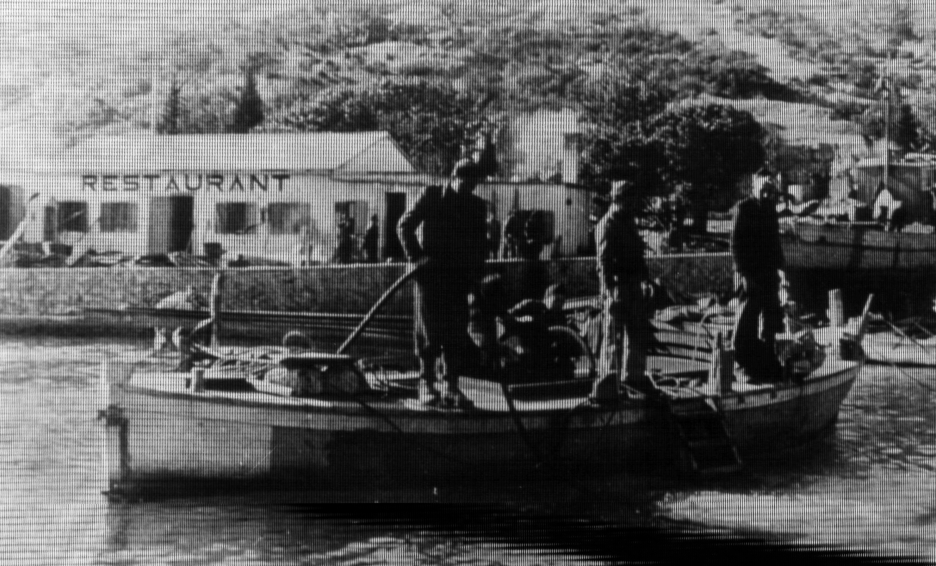
Antifascist graffiti from 1940s, “All for the defense of Vis” (Sve za obranu Visa)
Uz bogat program, od 7. do 10. rujna i uz obilježavanje 80. obljetnice oslobođenja od fašizma, na otoku Visu s radom započinje ISSA – Škola autonomije
Predavanja, radionice, atipične aturističke ture, eksperimentiranje s piratskom radio-stanicom, poezija, glazba i neizbježne radne akcije, sve nas to čeka od 7. do 10. rujna na otoku Visu.
Nakon što je početkom ljeta najavljeno pokretanje Škole autonomije na jednom od naših najudaljenijih naših otoka, među čijim su suosnivačima Srećko Horvat, Goran Bogdan, Hito Steyerl, Gael Garcia Bernal, Dora Held, Marko Pogačar te mnogi drugi, sada ISSA (Island School of Social Autonomy) i službeno kreće s radom.
Inauguracija škole neće se samo pozabaviti pitanjem i praksom autonomije danas, nego i time zašto se uopće pokreće, kakva je to točno škola i što sve može biti, što to “dobar život” znači u vremenima planetarne krize te kako izgraditi drugačiju budućnost kombinirajući tradicionalna znanja i moderne tehnologije.
Istovremeno, s obzirom da se 8. rujna obilježava 80 obljetnica kapitulacije Italije i oslobođenja otoka Visa – i drugih otoka i obale Dalmacije – od fašizma, Škola autonomije će dio programa posvetiti istraživanju i prezentaciji fascinantne povijesti otpora otoka Visa.
Jedan od vodećih suvremenih filozofa, Franco “Bifo” Berardi, održat će dva predavanja, prvo u Visu pod nazivom Kako ćemo živjeti? i to na dan kapitulacije Italije (8. rujna) u suradnji s Europskim centrom za studije rata i mira u impozantnoj palači Vukašinović-Dojmi de Lupis te drugo naslovljeno Za stvaranje škole nepredvidivog (9. rujna) na plaži u Komiži.
Bifo je posljednji put javno nastupio u Hrvatskoj prije šest godina kada je zajedno s pjevačem Primal Screama Bobbyjem Gillespijem gostovao kod Srećka Horvata na Filozofskom teatru u punoj dvorani HNK-a. U međuvremenu je redovito posjećivao Vis i sudjelovao u stvaranju Škole. Na hrvatskom jeziku nedavno je objavljena njegova knjiga Pobuna: O poeziji i financijama, a najavljena viška predavanja prava su filozofska poslastica.
Umjetnički kolektiv !Mediengruppe Bitnik također je dio Škole i dolazeiz Berlina da bi zajedno s Gordanom Savičićem i Selenom Savić vodili neobičnu aturističku turu “1 zvjezdice” (baziranu na recenzijama lokacija otoka Visa s jednom zvjezdicom). !Mediengruppe Bitnik poznati su po ometanju nadzornih kamera, postavljanju prislušnih uređaja u zgradu opere radi prenošenja izvedbe u vanjski svijet, slanju paketa s kamerom Julianu Assangeu u ekvadorsku ambasadu u Londonu i mnogim drugim intrigantnim radovima. U sklopu Škole predstavit će se i početno eksperimentiranje s piratskom radio stanicom na otoku.
U povodu 80. obljetnice oslobođenja otoka Visa od fašizma, filozof Srećko Horvat će održati “antifašističku turu Komižom” kroz zaboravljene ili potisnute povijesne lokacije, kao i danas postojeće tragove herojskog otpora otočana, dok će se uz suradnju s Gradom Komiža i Turističkom zajednicom grada Komiže, u subotu, 9. rujna održati prigodna proslava oslobođenja otoka Visa pod nazivom “Vinceremo – Vederemo!”, večer antifašističke poezije i glazbe na lokaciji gdje je 1943. u borbi s fašistima herojski poginuo Nikola Marinković “Top”.
Naziv tog programa dolazi od jednog događaja s početka fašističke okupacije Visa. Dok su talijanske trupe pristizale 30. travnja 1941. godine, domaće stanovništvo palilo je logorske vatre na većim brdima te su sva sela bila išarana antifašističkim grafitima. Talijanske slogane viška je mladež precrtavala, dodajući Vederemo („vidjet ćemo“) talijanskom Vinceremo („pobijedit ćemo“). Otpor fašističkoj vlasti pojavljivao se u mnogim oblicima.
Na godišnjicu Oktobarske revolucije 1942. godine, Nikola Marinković “Top”, sin siromašnog ribara, popeo se na vrh pedesetmetarskog zvonika komiške crkve “Muster” i razvio crvenu zastavu. Iako je mladić uspio pobjeći rafalnoj pucnjavi bijesnih talijanskih trupa koja je uslijedila, kasnije su ga ubili. Na ulici na kojoj je ubijen, do 90-ih je stajala spomen-ploča, međutim, ona je, kao i mnoge druge ploče posvećene tom povijesnom periodu i borbi otočana, srušena. Upravo na toj lokaciji održat će se proslava oslobođenja otoka uz prigodan program na kojem će antifašističku poeziju i zaboravljene borbe otoka Visa čitati glumci Milivoj Beader i Bruna Bebić, uz domaće snage s otoka i pokoje iznenađenje.
Kao zaokruženje četverodnevnog programa na kraju će se održati radna akcija u šumi na brdu gdje uporna skupina iza ovog poduhvata gradi Školu autonomije.
Ulaz na sve programe je besplatan.
Thursday 7.9.2023 … Komiža
Friday 8.9.2023 …. Vis
17:30–19:00
One-star review tour
with Selena Savić, Gordan Savičić & !Mediengruppe Bitnik (English & na našem jeziku)
Meeting place: Ferry Port
21:00
Warm Welcome & Short Program Presentation
Location: European Center for the Study of War and Peace, Matije Gupca 21, Vis
21:30
“How will we live?”
Franco “Bifo” Berardi – lecture (English)
Location: European Center for the Study of War and Peace, Matije Gupca 21, Vis
Saturday 9.9.2023 … Komiža
19:00
School on the beach
Location: Žanićevo žalo/ Ribarska
20:00
For the creation of a School of the Unpredictable
Franco “Bifo” Berardi – lecture (English)
Location: Žanićevo žalo/ Ribarska
22:00
Celebration of the liberation of island Vis from fascism
Vinceremo–Vederemo!
Milivoj Beader & surprise guests
Lokacija: Žanićovo žalo/ Ribarska
Sunday 10.9. 2023 … ISSA
15:00–20:00
School on the hill
Work action & Pirate Radio ISSA experimenting
Sign up: issa[at]hr.issa-school.org/ Location: ISSA – near Tito’s Cave