Tag: ivan illich

  • The “Dream Valley” Conspiracy

    The “Dream Valley” Conspiracy

    Towards Archipelagos of Permanent Autonomous Zones

    Photo: Old stone house
    ISSA before the reconstruction of the old stone house, 2022

    It all started with a sort of conspiracy.
    Now you probably think we’re crazy – flat-earthers, lizard people believers, X-Files fans, Davos conspiracy theorists, chemtrail enthusiasts, deep-state believers, Pizzagate supporters… or maybe a whole universe of conspiracies comes to mind.

    Conspiracy obviously became a bad word.
    Everything became a conspiracy, and conspiracy became everything.
    These days, just like genocide, conspiracy is live-streamed. 

    Who would be crazy enough to proclaim to be a conspirator.

    But what if there is no collective action or understanding of the world without conspiracy?

    When we say it all started with conspiracy, we think of the original, primordial conspiracy: the conspiracy of breathing together, not simply living together, in the same rhythm or in many different ones. 

    Among perceptive thinkers, at least three of them have deepened our understanding of conspiracy in relation to breathing and rhythm. One is the great educator Ivan Illich, the other is the semiotician Roland Barthes, and last but not least, our own conspirator Franco “Bifo” Berardi.

    In his lecture “The Cultivation of Conspiracy”, given in 1998 on the occasion of receiving the Culture and Peace Prize of Bremen, Illich reminds us that the origin of the word conspiracy and the prototype of conspiracy lies in the celebration of the early Christian liturgy in which, no matter the origin, men and women, Greeks and Jews, slaves and citizens, engender a physical reality that transcends them. The shared breath, the con-spiratio, is the peace understood as the community that arises from it.

    “Community”, says Illich a few years before his death, “is not the outcome of an act of authorative foundation, nor a gift from nature or its gods, nor the result of management, planning and design, but the consequence of a conspiracy, a deliberate, mutual, somatic and gratutious gift to each other.”

    The original meaning of conspiratio, which brings us closer to Roland Barthes, comes from the mouth-to-mouth kiss among the faithful attending services: originally it represented a commoning of breath. 

    At his late lectures at Collège de France, later published as How To Live TogetherRoland Barthes became captivated by communities in which everyone follows their own rhythms, while at the same time there are parts of the community that have a common rhytm. The main objective of these communities, according to Barthes, was “to safeguard rhuthmos, that is to say, a flexible, free mobile rhythm; a transitory, fleeting form, but a form nonetheless”.

    These kind of “idiorryhythmic constellations” and forms of living together came to life in the Syrian and Egyptian deserts. Throughout human history anchorites, hermits, and outcasts sought to escape the rules and control of higher powers. The rhythm Barthes researched was a rhythm “that allows for approximation, for imperfection, for a supplement, a lack, an idios: what doesn’t fit the structure”. 

    “There is a consubstantial relationship between power and rhythm”, warns Barthes, “before anything else, the first thing that the power imposes is a rhythm (to everything: a rhythm of life, of time, of thought, of speech.” 

    In his book Breathing: Chaos and Poetry, published just a year before the brutal murder of George Floyd and the onset of the COVID-19 pandemic, one of the conspirators behind ISSA, Franco “Bifo” Berardi, claims that the words “I can’t breathe” expresses the general sentiment of our times: 

    “Physical and psychological breathlessness everywhere, in the megacities choked by pollution, in the precarious social condition of the majority of exploited workers, in the pervading fear of violence, war, and aggression.”

    It is precisely respiration that, according to Bifo, can help us understand the contemporary chaos: the process of “breathing with chaos” or “chaosmosis”, which he defines as ‘osmosis with chaos’, is where a “new harmony emerges, a new sympathy, a new syntony.’”

    We need to not only learn how to breathe together again but also how to breathe with chaos. 

    “Dream Valley” on Vis
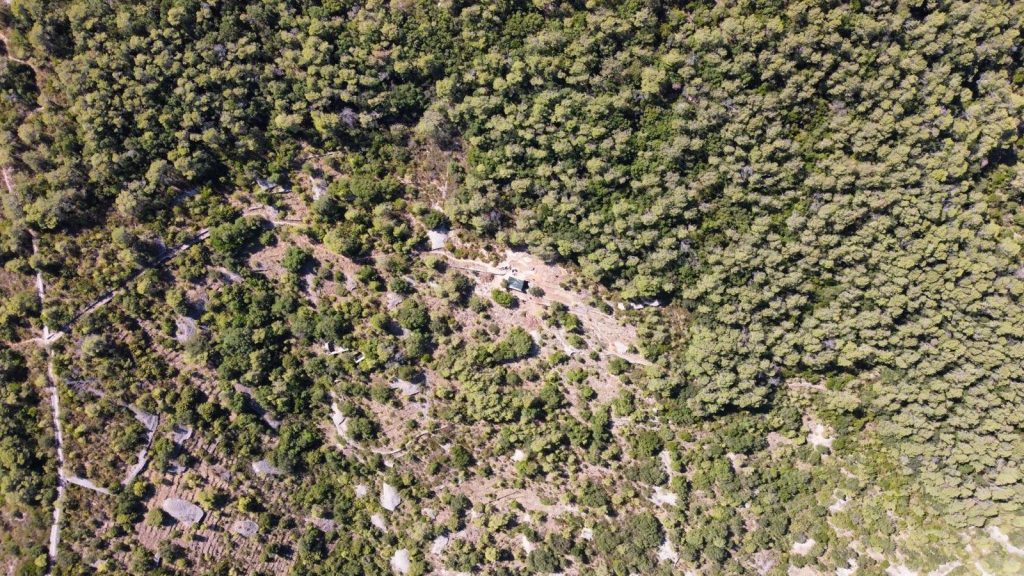
    S’nova dolca, “The Dream Valley”, island Vis

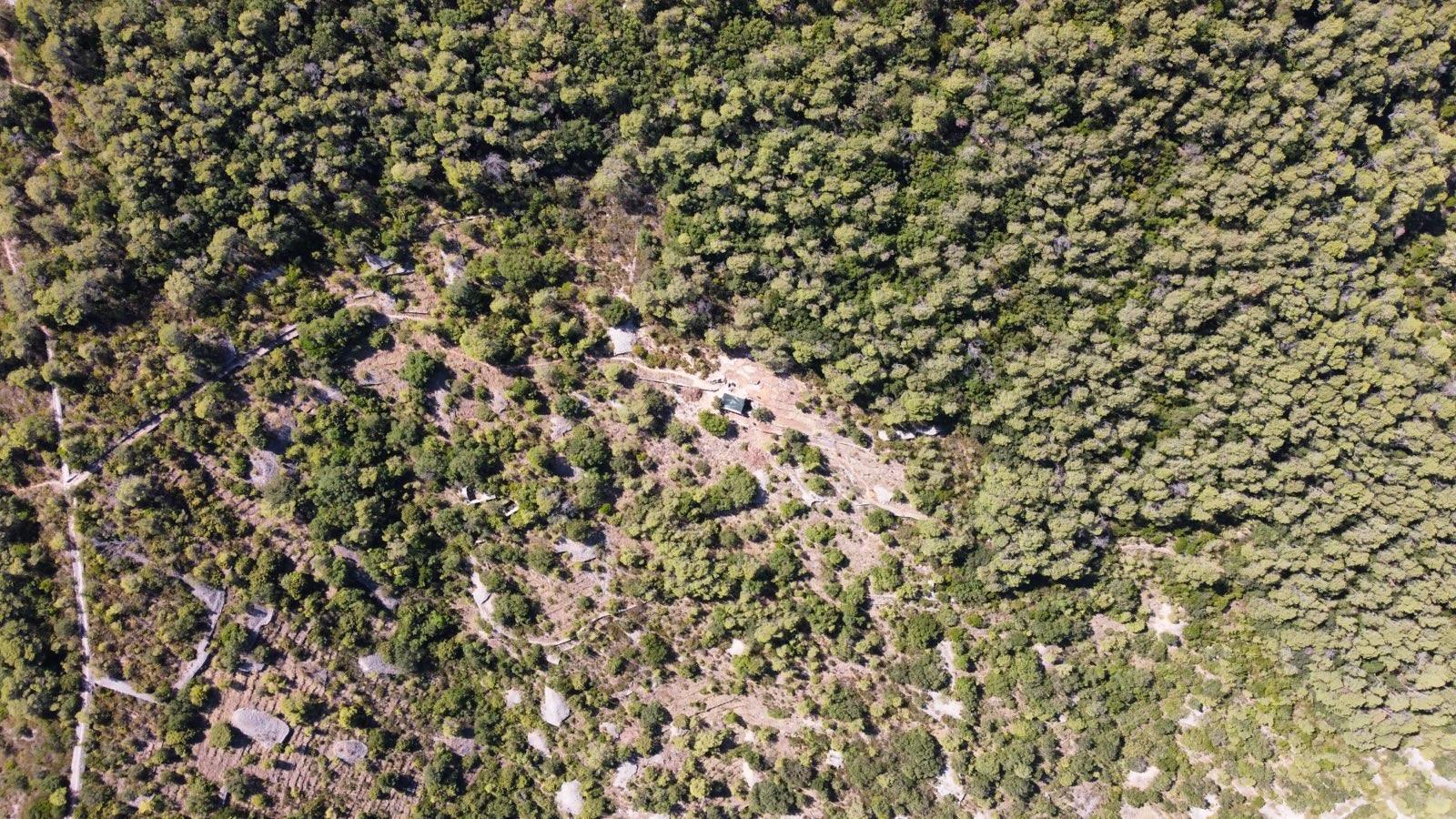
    When we first arrived to the “Dream Valley” on the island of Vis, a dense, overgrown pine forest covered the land. 

    The last time it was cultivated was more than half a century ago, half a century before we placed our feet and hands on it – to establish a school from the future, on a remote Adriatic Island. 

    The only remnants on that hill near Tito’s cave, for several centuries cultivated as fruitful vineyards, were the ruins of an old stone house once used for wine storage and a small area to shelter a donkey, the true proleterian among animals. 

    The donkey, one of the symbols of the Meditteranean, was domesticated approximately five to seven thousand years ago in Africa and since then, after spreading rapidly through Eurasia, it was mainly used for work. Donkeys were champions of carrying. But we could find none on our island to help us carry the material uphill in order to reconstruct the old stone house. 

    The glorious – and strenuous – time of the donkey, at least in this part of the world, was done. The owners of the few remaining donkeys on the island rightly concluded that borrowing them for our crazy project would be too demanding on the first proletarians.

    So, we had no other option but to carry quite literaly tons and tons of material: from wood, sand and gravel to tools and hundreds of books by hand and foot. Luckily, thanks to an early donation by our only seemingly unlikely conspirator, Pamela Anderson, the first tools we invested in – after realizing the symbol and soul of the Meditteranean is disappearing – were “electric donkeys”.

    The “electric donkey” can also be used for transfer of books to ISSA

    We still carry tons of material uphill by hand and foot, but now we at least have the benefit of modern technology: two electric wheelbarrows. But even with our “electric donkeys”, our project still sometimes reminds us of a Mediterranean version of Fitzcarraldo.

    We are not Klaus Kinski in Werner Herzog’s movie transporting a steamship over the Anders mountains to build an opera house, but we are determined to build our School in the forest in the hills, with no option but to carry everything uphill. 

    We do not plan to build an opera house, that is a bit too bourgeois for us. Although even an opera could take place here. 

    Besides renovating the old stone house and transforming it into the headquaters for the island school – with water and solar power, compost toilets and showers, classrooms in the middle of nature, residencies, and a library – we are also dreaming of creating an amphitheater in the “Dream Valley”.

    The part of the island where ISSA is being born is originally called Sinova dolca (the “Son’s Valley”), but also S’nova dolca, which could be interpreted as “Dream Valley”.  At least that is the meaning we like to ascribe to it.

    Who are we and why are we doing this? 

    At first, people thought we were crazy. Many islanders probably still think so.

    Why would anyone, in times of global tourism and global crisis, invest their time and life into something so slow and without any financial profit? 

    Why would anyone build a school on a remote island in the midst of the Adriatic Sea, in a part of the island that was abandoned overgrown by forests for more than half a century?

    Who are we?

    We are wild dreamers, artists and poets, philosophers and activists, drystonewallers and builders, who got tired of waiting for the “day after”, the day after a fundamental event that would change the contemporary way we live together, not only among humans, but among other species, with animals and all other sorts of living beings, including our only planet. 

    Why are we doing this?

    We are not preppers. We are not preparing for the “day after” the cataclysm. We know it has already happened.

    We are not merely concerned with our own survival nor are we interested in surviving for survival’s sake. 

    Unlike the current-day preppers, with their private jets, nuclear bunkers, libertarian cities and escape plans to New Zealand or Mars, we are not abandoning humanity or the planet.

    As D. H. Lawrence memorably said in Lady Chatterley’s Lover

    “Ours is essentially a tragic age, so we refuse to take it tragically. The cataclysm has happened, we are among the ruins, we start to build up new little habitats, to have new little hopes… We’ve got to live, no matter how many skies have fallen”.

    We’ve got to live, no matter how many skies have fallen.

    But how do we need to live? 

    What kind of habitats can we and must we build? 

    Slowly, we arrive at the age-old question of philosophy: What is “good life”?

    And what is “good life” in our contemporary times, in the end of times, in times of extinction? 

    But before, if ever, we arrive to a proper – ontological, ethical, political, social – answer to this crucial question, we must go back to the island, to this place on Earth that was always, even when it was still a mountain, connected to the mainland. 

    And before we come back to the future island, we must place it somewhere.

    We must place it in the archipelago. 

    What is an archipelago?

    The most common definition of an archipelago is a “group of islands”, but this standard definition mainly addresses its spatial dimension. 

    An archipelago is not only temporal occurrence, it is both spatial and temporal, geological and cultural, natural, and artificial.

    The word archipelago originally comes from arche, from the Greek word for “original”, “principal”, “source of action”, “first principle”, and pelago, meaning “deep”, “sea” and – “abyss”. 

    Interestingly, the great Croatian poet Tin Ujević, in his beautiful text on the island of Vis, Komiža and the archipelago where we founded ISSA (“Nit u srcu mora: Komiža na Visu“, 1930) mentions the connection between the origin of the word of Adriatic and its relation to the abyss:

    “Finally, in a mournful, bathed wasteland, I personally rehearsed an impossible thing, happiness. It was an escape from all the pressures of reality. Here I took into my soul all the infinite seas on which I have never vomited, and who would not want to live like this in nature, in an oceanic, Otahite happiness? I said: Vis is dearer to me than the entire Adriatic, and Saint Andrew is even dearer to me than Vis. Atlantic and Pacific waters come to me, not just the Adriatic. And that Hadria, I told the listeners, comes from the Dravidian word ‘Hodru’, which in Dravidian means Abyss (abyss), because in ancient times, water really broke through here and submerged inhabited and cultivated areas.”

    Geological evidence we have today proves that, indeed, that is how the Adriatic was created when water submerged the land. 

    This archipelago and its future islands were a result of an abbys of gigantic proportions, a consequence of an underwater volcano more than 220 million years ago, when the supercontinent Pangea still dominated the world.

    Around 20,000 years ago, during the Last Glacial Maximum, sea levels began to rise in the Adriatic region. From the top of the hill at ISSA, we can see what is now called Dalmatia and the highest parts of the Dinaric Mountains along the eastern coast of the Adriatic. All the islands we can see from here – Hvar, Brač, Korčula, Pelješac – were once part of the mainland. 

    The Adriatic during the Last Glacial Maximum, around 20,000 years ago

    Before the ice started melting, the Adriatic Sea was 120 meters lower, and hunter-gatheres were still roaming through its valleys. As sea levels began rising, soon they had to adopt and find other ways of survival. Now, it was the sea that was the future. Then came the agricultural revolution, herding and domestication of animals. And the donkeys.

    But it would be wrong to think of the Neolithic and agricultural revolution as an event, a sudden change, like a rapid rise in sea levels and hunter-gatherers immediately stopping hunting for animals and becoming fishermen. The available data shows that the Neolithisation of the Adriatic was a complex and arrhytmic process that took almost a thousand years to establish. 

    Here the recent book by David Wengrow & David GraeberDawn of Everything, is useful to get a better understanding of history as an archipelagic process itself. 

    Unlike Steven Pinker or Yuval Noah Harari and their teleological notion of history connected to the ideology of “progress”, Wengrow and Graeber convincingly argued that long after the agricultural revolution, there was no fixed model of social organisation but a multiplicity of social arrangements. In short, our prehistory was not uniform but consisted of myriad forms of living together – even before the agricultural revolution, there were large cities, some monarchies, some egalitarian, others were seasonal. 

    In short, history and social change itself is an archipelagic process. 

    So, what is an archipelago? 

    It is a document of a previous catastrophe, of many previous catastrophes. 

    And of renewal, at the same time. 

    What was once a catastrophe is now today’s archipelago. 

    What was once a mountain, is now an island. 

    An archipelago is evidence of both revolution and evolution. 

    What is an island? 

    An island, even though the word in many Slavic languages originates from “stream” and “current” (Croatian otok from tokteći okolo, Serbian ostrvo from strujastream, Slovak ostrov, Ukranian ostriv), is not simply a place sourrounded by water. 

    As Gilles Deleuze notes in Desert Islands: “It is an island or a mountain, or both at once: the island is a mountain under water, and the mountain, an island that is still dry. Here we see original creation caught in a re-creation, which is concentrated in a holy land in the middle of the ocean.”

    Gilles Deleuze on a beach, Big Sur, California, 1975 (Photo by Jean-Jacques Lebel)

    In other words, to perceive an island as an island would mean not to perceive geology, the vast past and major planetary events that have led to what would become future islands. 

    Deleuze goes on even more poetically: 

    “Some islands drifted away from the continent, but the island is also that toward which one drifts; other islands originated in the ocean, but the island is also the origin, radical and absolute. Certainly, separating and creating are not mutually exclusive: one must hold one’s own when one is separated, and had better be separated to create anew; nevertheless, one of the two tendencies always predominates. In this way, the movement of the imagination of islands takes up the movement of their production, but they do not have the same objective. It is the same movement, but a different goal. It is no longer the island that is separated from the continent, it is humans who find themselves separated from the world when on an island. It is no longer the island that is created from the bowels of the earth through the liquid depths, it is humans who create the world anew from the island and on the waters. “

    So, what is an island?

    An island is primarily a possibility to construct not only a different spatiality, but a different temporality, ways of living-together, of co-breathing, of having a rhythm or idiorhythmy. 

    An island is also an object of desire. 

    A sort of utopian desire: from Plato’s travel to Sicily in order to convince a tyrant of his ideal society, Thomas More’s Utopia depicting a fictional island society, Shakespeare’s The Tempest taking place on a remote magical island, Aldous Huxley’s Island, the legendary pirate haven Libertalia placed on Madagascar, or even Hollywood blockbusters such as The Beach with Leonardo di Caprio placed on Thailand (and ruined its beautiful beach by over-tourism). 

    But an island also, very often, turns out to become a dystopia. Think of William Golding’s Lord of Flies set on a remote, uninhabited tropical island or of, more recently, Hunger Games set in a post-apocalyptic archipelago and Michel Houllebecq’s The Possibility of an Island

    When you think of islands, it is impossible not to think of colonialism and imperialism at the same time. 

    You can also think of Próspera, a private libertarian island in Honduras. Or you could think of Praxis

    But be warned: this is not to be confused with the famous 20th century Yugoslav philosophical school called Praxis which organized the Korčula Summer School on an Adriatic island. The new Praxis is another libertarian dream of a private island somewhere in the Mediterranean. 

    As long as there are islands, the tension between utopia and dystopia was and always will exist.

    And we are not ashamed to be called naive, romantic, or even crazy for trying to bring to life the utopian desire of our future islands. 

    A gratuitous gift to each other

    As we carry tons of material uphill, while we build and share our breaths and rhythms in the “Dream Valley”, we are not simply building a school. The school is, as we love to say, building us. 

    What we are learning once again is how to breathe together – how, through cooperation and the pure joy of community building, we can create something bigger than ourselves, both in terms of the individuals involved and temporality behind and in front of us. 

    We have learned patience and pomalo from the island through its nature, the climate, the winds, and the waves, its people, and its traditions. 

    We have also learned that we must embrace – following the footsteps of the great philosopher from Martinique, Édouard Glissant – the archipelagic thought as an alternative epistemology and way of thinking that accepts ambiguities, different rhythms, ruptures, and interactions of all sorts. 

    Unlike the continental thought, this archipelagic, southern thought – and practice (praxis) – challenges the universalistic idea of thought promoted by the Enlightenment, which not only diminished all non-Western knowledge, but also prepared ground for imperialism, colonialism and totalitarianism. 

    In his essay on Herman Melville, Gilles Deleuze writes about an affirmation of the world as process and as an archipelago. He understands archipelagoes as a “world in process,” which is connected to multiplicity. 

    It all starts from “the affirmation of a world in process, an archipelago. Not even a puzzle, whose pieces when fitted together, would form a whole, but rather a wall of loose, uncemented stones, where every element has a value in itself but also in relation to others: isolated and floating relations, islands and straits, immobile points, and sinuous lines. ” 

    And it is here where we arrive at a quite unexpected encounter. The encounter between Deleuze and one of our favorite activities at ISSA – namely, dry stone walling.

    Building uncemented stones has been an integral part of the Mediterranean for centuries, even millenia. The function of dry-stone walls vary and can be all at the same time – protection against soil erosion, collection of water, protection against wind, landscape architecture…

    What Deleuze, although you never imagine him as a dry stone waller, points towards are the archipelagic nature of the stone walls themselves. While walls are usually built to divide, they were also used to connect and provide well-being to communities around the Meditteranean. 

    We are not only interested in learning from those who have thought future islands in myriad ways before us, we are keen to learn from dry stone walls, from the oak tree in front of our School, from the cicadas and their ryhthms, from the winds and from the island itself. 

    We are not interested in building a sort of a temporary autonomous zone. We know everything is temporary.

    Yet there is also eternity by the stars, as Louis-Auguste Blanqui, another great conspirator who spent over half of his adult life in jail, declared in his “astronomical hypothesis” in the year of the Paris Commune. 

    In this eternity by the stars, we are opening our sails towards archipelagos of permanent autonomous zones.

    These zones already exist in many places of the world, as a consequence of conspiracy, a deliberate, mutual, somatic, and gratuitous gift to each other.

    We are not the first, and hopefully not the last.

    Srećko Horvat, September 2024, Vis

  • Illich: Silence is a Commons

    Illich: Silence is a Commons

    Computers are doing to communication what fences did to pastures and cars did to streets.

    This article is from Illich’s remarks at the “Asahi Symposium Science and Man – The computer-managed Society,” Tokyo, Japan, March 21, 1982.

    Minna-san, gladly I accept the honour of addressing this forum on Science and Man. The theme that Mr. Tsuru proposes, “The Computer-Managed Society,” sounds an alarm. Clearly you foresee that machines which ape people are tending to encroach on every aspect of people’s lives, and that such machines force people to behave like machines. The new electronic devices do indeed have the power to force people to “communicate” with them and with each other on the terms of the machine. Whatever structurally does not fit the logic of machines is effectively filtered from a culture dominated by their use.

    The machine-like behaviour of people chained to electronics constitutes a degradation of their well-being and of their dignity which, for most people in the long run, becomes intolerable. Observations of the sickening effect of programmed environments show that people in them become indolent, impotent, narcissistic and apolitical. The political process breaks down, because people cease to be able to govern themselves; they demand to be managed.

    I congratulate Asahi Shimbun on its efforts to foster a new democratic consensus in Japan, by which your more than seven million readers become aware of the need to limit the encroachment of machines on the style of their own behaviour. It is important that precisely Japan initiate such action. Japan is looked upon as the capital of electronics; it would be marvellous if it became for the entire world the model of a new politics of self-limitation in the field of communication, which, in my opinion, is henceforth necessary if a people wants to remain self-governing.

    Electronic management as a political issue can be approached in several ways. I propose, at the beginning of this public consultation, to approach the issue as one of political ecology. Ecology, during the last ten years, has acquired a new meaning. It is still the name for a branch of professional biology, but the term now increasingly serves as the label under which a broad, politically organized general public analyzes and influences technical decisions. I want to focus on the new electronic management devices as a technical change of the human environment which, to be benign, must remain under political (and not exclusively expert) control. I have chosen this focus for my introduction, because I thus continue my conversation with those three Japanese colleagues to whom I owe what I know about your country – Professors Yoshikazu Sakamoto, Joshiro Tamanoi and Jun Ui.

    In the 13 minutes still left to me on this rostrum I will clarify a distinction that I consider fundamental to political ecology. I shall distinguish the environment as commons from the environment as resource. On our ability to make this particular distinction depends not only the construction of a sound theoretical ecology, but also – and more importantly – effective ecological jurisprudence Minna-san, how I wish, at this point, that I were a pupil trained by your Zen poet, the great Basho. Then perhaps in a bare 17 syllables I could express the distinction between the commons within which people’s subsistence activities are embedded, and resources that serve for the economic production of those commodities on which modem survival depends. If I were a poet, perhaps I would make this distinction so beautifully and incisively that it would penetrate your hearts and remain unforgettable. Unfortunately I am not a Japanese poet. I must speak to you in English, a language that during the last 100 years has lost the ability to make this distinction, and – in addition – I must speak through translation. Only because I may count on the translating genius of Mr. Muramatsu do I dare to recover Old English meanings with a talk in Japan.

    “Commons” is an Old English word. According to my Japanese friends, it is quite close to the meaning that iriai still has in Japanese “Commons,” like iriai, is a word which, in preindustrial times, was used to designate certain aspects of the environment. People called commons those parts of the environment for which customary law exacted specific forms of community respect. People called commons that part of the environment which lay beyond their own thresholds and outside of their own possessions, to which, however, they had recognized claims of usage, not to produce commodities but to provide for the subsistence of their households. The customary law which humanized the environment by establishing the commons was usually unwritten. It was unwritten law not only because people did not care to write it down, but because what it protected was a reality much too complex to fit into paragraphs. The law of the commons regulates the right of way, the right to fish and to hunt, to graze, and to collect wood or medicinal plants in the forest.

    An oak tree might be in the commons. Its shade, in summer, is reserved for the shepherd and his flock; its acorns are reserved for the pigs of the neighbouring peasants; its dry branches serve as fuel for the widows of the village; some of its fresh twigs in springtime are cut as ornaments for the church – and at sunset it might be the place for the village assembly. When people spoke about commons, iriai, they designated an aspect of the environment that was limited, that was necessary for the community’s survival, that was necessary for different groups in different ways, but which, in a strictly economic sense, was not perceived as scarce.

    When today, in Europe, with university students I use the term “commons” (in German Almende or Gemeinheit, in Italian gli usi civici) my listeners immediately think of the eighteenth century. They think of those pastures in England on which villagers each kept a few sheep, and they think of the “enclosure of the pastures” which transformed the grassland from commons into a resource on which commercial flocks could be raised. Primarily, however, my students think of the innovation of poverty which came with enclosure: of the absolute impoverishment of the peasants, who were driven from the land and into wage labour, and they think of the commercial enrichment of the lords.

    In their immediate reaction, my students think of the rise of a new capitalist order. Facing that painful newness, they forget that enclosure also stands for something more basic. The enclosure of the commons inaugurates a new ecological order: Enclosure did not just physically transfer the control over grasslands from the peasants to the lord. Enclosure marked a radical change in the attitudes of society towards the environment. Before, in any juridical system, most of the environment had been considered as commons from which most people could draw most of their sustenance without needing to take recourse to the market. After enclosure, the environment became primarily a resource at the service of “enterprises” which, by organizing wage-labor, transformed nature into the goods and services on which the satisfaction of basic needs by consumers depends. This transformation is in the blind spot of political economy.

    This change of attitudes can be illustrated better if we think about roads rather than about grasslands. What a difference there was between the new and the old parts of Mexico City only 20 years ago. In the old parts of the city the streets were true commons. Some people sat on the road to sell vegetables and charcoal. Others put their chairs on the road to drink coffee or tequila. Others held their meetings on the road to decide on the new headman for the neighbourhood or to determine the price of a donkey. Others drove their donkeys through the crowd, walking next to the heavily loaded beast of burden; others sat in the saddle. Children played in the gutter, and still people walking could use the road to get from one place to another.

    Such roads were not built for people. Like any true commons, the street itself was the result of people living there and making that space liveable. The dwellings that lined the roads were not private homes in the modern sense – garages for the overnight deposit of workers. The threshold still separated two living spaces, one intimate and one common. But neither homes in this intimate sense nor streets as commons survived economic development.

    In the new sections of Mexico City, streets are no more for people. They are now roadways for automobiles, for buses, for taxis, cars, and trucks. People are barely tolerated on the streets unless they are on their way to a bus stop. If people now sat down or stopped on the street, they would become obstacles for traffic, and traffic would be dangerous to them. The road has been degraded from a commons to a simple resource for the circulation of vehicles. People can circulate no more on their own. Traffic has displaced their mobility. They can circulate only when they are strapped down and are moved.

    The appropriation of the grassland by the lords was challenged, but the more fundamental transformation of grassland (or of roads) from commons to resource has happened, until recently, without being subjected to criticism. The appropriation of the environment by the few was clearly recognized as an intolerable abuse By contrast, the even more degrading transformation of people into members of an industrial labour force and into consumers wastaken, until recently, for granted. For almost a hundred years the majority of political parties has challenged the accumulation of environmental resources in private hands. However, the issue was argued in terms of the private utilization of these resources, not the distinction of commons. Thus anticapitalist politics so far have bolstered the legitimacy of transforming commons into resources.

    Only recently, at the base of society, a new kind of “popular intellectual” is beginning to recognize what has been happening. Enclosure has denied the people the right to that kind of environment on which – throughout all of history – the moral economy of survival had been based. Enclosure, once accepted, redefines community. Enclosure underlines the local autonomy of community. Enclosure of the commons is thus as much in the interest of professionals and of state bureaucrats as it is in the interest of capitalists. Enclosure allows the bureaucrats to define local community as impotent – “ei-ei schau-schau!!!” – to provide for its own survival. People become economic individuals that depend for their survival on commodities that are produced for them. Fundamentally, most citizens’ movements represent a rebellion against this environmentally induced redefinition of people as consumers.

    Minna-san, you wanted to hear me speak on electronics, not grassland and roads. But I am a historian; I wanted to speak first about the pastoral commons as I know them from the past in order then to say something about the present, much wider threat to the commons by electronics.

    This man who speaks to you was born 55 years ago in Vienna. One month after his birth he was put on a train, and then on a ship and brought to the Island of Brac. Here, in a village on the Dalmatian coast, his grandfather wanted to bless him. My grandfather lived in the house in which his family had lived since the time when Muromachi ruled in Kyoto. Since then on the Dalmatian Coast many rulers had come and gone – the doges of Venice, the sultans of Istanbul, the corsairs of Almissa, the emperors of Austria, and the kings of Yugoslavia. But these many changes in the uniform and language of the governors had changed little in daily life during these 500 years. The very same olive-wood rafters still supported the roof of my grandfather’s house. Water was still gathered from the same stone slabs on the roof. The wine was pressed in the same vats, the fish caught from the same kind of boat, and the oil came from trees planted when Edo was in its youth.

    My grandfather had received news twice a month. The news now arrived by steamer in three days; and formerly, by sloop, it had taken five days to arrive. When I was born, for the people who lived off the main routes, history still flowed slowly, imperceptibly. Most of the environment was still in the commons. People lived in houses they had built; moved on streets that had been trampled by the feet of their animals; were autonomous in the procurement and disposal of their water; could depend on their own voices when they wanted to speak up. All this changed with my arrival in Brac.

    On the same boat on which I arrived in 1926, the first loudspeaker was landed on the island. Few people there had ever heard of such a thing. Up to that day, all men and women had spoken with more or less equally powerful voices. Henceforth this would change. Henceforth the access to the microphone would determine whose voice shall be magnified. Silence now ceased to be in the commons; it became a resource for which loudspeakers compete. Language itself was transformed thereby from a local commons into a national resource for communication. As enclosure by the lords increased national productivity by denying the individual peasant to keep a few sheep, so the encroachment of the loudspeaker has destroyed that silence which so far had given each man and woman his or her proper and equal voice. Unless you have access to a loudspeaker, you now are silenced.

    I hope that the parallel now becomes clear. Just as the commons of space are vulnerable, and can be destroyed by the motorization of traffic, so the commons of speech are vulnerable, and can easily be destroyed by the encroachment of modem means of communication.

    The issue which I propose for discussion should therefore be clear: how to counter the encroachment of new, electronic devices and systems upon commons that are more subtle and more intimate to our being than either grassland or roads – commons that are at least as valuable as silence. Silence, according to western and eastern tradition alike, is necessary for the emergence of persons. It is taken from us by machines that ape people. We could easily be made increasingly dependent on machines for speaking and for thinking, as we are already dependent on machines for moving.

    Such a transformation of the environment from a commons to a productive resource constitutes the most fundamental form of environmental degradation. This degradation has a long history, which coincides with the history of capitalism but can in no way just be reduced to it. Unfortunately the importance of this transformation has been overlooked or belittled by political ecology so far. It needs to be recognized if we are to organize defense movements of what remains of the commons. This defense constitutes the crucial public task for political action during the eighties. The task must be undertaken urgently because commons can exist without police, but resources cannot. Just as traffic does, computers call for police, and for ever more of them, and in ever more subtle forms.

    By definition, resources call for defense by police. Once they are defended, their recovery as commons becomes increasingly difficult. This is a special reason for urgency.


    The CoEvolution Quarterly, Winter 1983

  • Ivan Illich: “Deschooling Society”

    Ivan Illich: “Deschooling Society”

    Below you can find the introduction to Ivan Illich’s Deschooling Society, as well as the link to the PDF of the entire book – enjoy!

    INTRODUCTION

    I owe my interest in public education to Everett Reimer. Until we first met in Puerto Rico in 1958, I had never questioned the value of extending obligatory schooling to all people. Together we have come to realize that for most men the right to learn is curtailed by the obligation to attend school. The essays given at CIDOC and gathered in this book grew out of memoranda which I submitted to him, and which we discussed during 1970, the thirteenth year of our dialogue. The last chapter contains my after- thoughts on a conversation with Erich Fromm on Bachofen’s Mutterrecht.

    Since 1967 Reimer and I have met regularly at the Center for Intercultural Documentation (CIDOC) in Cuernavaca, Mexico. Valentine Borremans, the director of the Center, also joined our dialogue, and constantly urged me to test our thinking against the realities of Latin America and Africa. This book re- flects her conviction that the ethos, not just the institutions, of society ought to be “deschooled.”

    Universal education through schooling is not feasible. It would be no more feasible if it were attempted by means of alternative institutions built on the style of present schools. Neither new attitudes of teach- ers toward their pupils nor the proliferation of educational hardware or software (in classroom or bed- room), nor finally the attempt to expand the pedagogue’s responsibility until it engulfs his pupils’ life- times will deliver universal education. The current search for new educational funnels must be reversed into the search for their institutional inverse: educational webs which heighten the opportunity for each one to transform each moment of his living into one of learning, sharing, and caring. We hope to con- tribute concepts needed by those who conduct such counterfoil research on education — and also to those who seek alternatives to other established service industries.

    On Wednesday mornings, during the spring and summer of 1970, I submitted the various parts of this book to the participants in our CIDOC programs in Cuernavaca. Dozens of them made suggestions or provided criticisms. Many will recognize their ideas in these pages, especially Paulo Freire, Peter Berger, and Jose Maria Bulnes, as well as Joseph Fitzpatrick, John Holt, Angel Quintero, Layman Allen, Fred Goodman, Gerhard Ladner, Didier Piveteau, Joel Spring, Augusto Salazar Bondy, and Dennis Sul- livan. Among my critics, Paul Goodman most radically obliged me to revise my thinking. Robert Silvers provided me with brilliant editorial assistance on Chapters 1, 3, and 6, which have appeared in The New York Review of Books.

    Reimer and I have decided to publish separate views of our joint research. He is working on a compre- hensive and documented exposition, which will be subjected to several months of further critical ap- praisal and be published late in 1971 by Doubleday & Company. Dennis Sullivan, who acted as secre-

    tary at the meetings between Reimer and myself, is preparing a book for publication in the spring of 1972 which will place my argument in the context of current debate about public schooling in the United States. I offer this volume of essays now in the hope that it will provoke additional critical contributions to the sessions of a seminar on “Alternatives in Education” planned at CIDOC in Cuernavaca for 1972 and 1973.

    I intend to discuss some perplexing issues which are raised once we embrace the hypothesis that soci- ety can be deschooled; to search for criteria which may help us distinguish institutions which merit de- velopment because they support learning in a deschooled milieu; and to clarify those personal goals which would foster the advent of an Age of Leisure (schole) as opposed to an economy dominated by service industries.

    DESCHOOLING SOCIETY by Ivan Illich (you can find the PDF here)

  • Ivan Illich on Education

    Ivan Illich on Education

    Ivan Illich, whose work is one of the sources of inspiration for the ISSA, talks with Jean-Marie Domenach in Paris in 1972.

    The conversation focuses on the myth of Pandora, Epimetheus, and Prometheus, on the replacement of hope by expectation, on compulsory schooling as the “organ of reproduction” of capitalist values, on the need for a policy of consensual upper limits for the applications of technology… up to personal friendship as the foundation of work in the world.

    The entire conversation can be found below: